

IGNOU Online
Global Executives & Professionals – 2,500+ | Doctoral Candidates – 5,000+ | Global Batches – 75+
Home >> University >> IGNOU
Indira Gandhi National Open University (IGNOU) is not that kind of university. It is the world’s largest university by active enrolment, over 3 million students and it did not become the world’s largest by competing with IITs, IIMs, or DU for the same 18-year-old, full-time residential student.
- Accreditation: NAAC A++ | UGC | AICTE | AIU | NIRF
- Courses for Working Professionals
- Study Mode: Fully online
- Network Building & Alumni Connects
- EMI Options: You’ll have access to budget-friendly payment plans
- Last date of admission: OnGoing
This information is provided for audience reference only. The video has been sourced from YouTube as a free resource. We are not affiliated with the YouTube channel or its creators. The views and opinions expressed in the video are their own.
Learn From Top Ranked Doctorate Institutes & Universities




 Latest Updates
According to Press Information Bureau, At its 39th Convocation on April 7, 2026, held simultaneously across 55 Regional Centres, IGNOU conferred degrees and diplomas on 3,24,835 (324,835) learners worldwide, with India’s Vice-President C.P. Radhakrishnan delivering the convocation address.
About IGNOU
IGNOU became the world’s largest by reaching every category of person that every other university in India had structurally excluded:
- A woman in rural Rajasthan who stopped studying after Class 12 because there was no college nearby.
- Defence personnel posted in a remote border area with no access to conventional campuses
- Factory worker in Coimbatore who wants a degree without resigning
- Jail inmate in Maharashtra who wants to study during incarceration
- 45-year-old schoolteacher in Assam who never completed a postgraduate degree
- Indian diaspora student in Kenya or Mauritius or the Caribbean who wants an Indian university degree.
IGNOU now offers 325 programmes (including 45 online academic programmes through its own LMS and FYUP Four Year Undergraduate Programmes aligned with NEP 2020) through 21 Schools of Studies. Its network spans 69 Regional Centres across every state and union territory, over 2,667 Learner Support Centres including study centres at prisons, hospitals, military stations, and remote tribal areas, and 25 Overseas Study Centres in 15 countries including the UAE, Oman, Bahrain, Sri Lanka, Mauritius, Maldives, Nepal, Kenya, Fiji, Caribbean Islands, Malaysia, Kyrgyzstan, Singapore, Ghana, and Samoa. Its cumulative international student enrolment stands at approximately 92,000. In the 2023–24 admission cycle alone, 753,286 fresh registrations were recorded of which 352,354 enrolled in bachelor’s degree programmes, with the BAG (Bachelor of Arts General) being the most popular at 109,840 registrations.
The academic quality framework is similarly inclusive. NAAC has awarded IGNOU an A++ grade the highest accreditation grade available in India, and IGNOU is the first Open University to receive it. NIRF 2025 has ranked it #1 in the “Open Universities” category. It is recognised as a Central University by UGC. AICTE recognises its MCA and MBA programmes. The Distance Education Council (DEC) which operates under IGNOU’s mandate per Clause 16 and Statute 28 of the IGNOU Act is the national accreditor for all open universities and distance education systems in India. IGNOU thus holds the unusual distinction of being both a university and the national regulatory authority for its own sector a constitutional position that no other university in India occupies.
Ranking & Approvals of IGNOU

AACSB Member
IGNOU holds NAAC A++ grade - the highest accreditation grade available from the National Assessment and Accreditation Council.
UGC Recognition
IGNOU is recognised as a Central University by the University Grants Commission of India.
AIU Recognition
The Association of Indian Universities (AIU) recognises IGNOU degrees as equivalent to those conferred by its member universities - meaning the full equivalence applies across India's entire university membership.

NIRF Ranking
NIRF 2025 ranks IGNOU #1 in the Open Universities category - the top position in its class.
Build the Right Skills & Shape Your Future from Our Unbiased Career Counselling. Choose the right path and Get 100 % Unbiased Career Advice.
Claim Your 100% Free Guidance on 100+ Online Universities
Why Choose IGNOU
World’s Largest University – 3+ Million Active Students
IGNOU is not merely the largest university in India, it is the largest university in the world by active enrolment, with over 3 million students studying simultaneously. NIRF 2025 ranks it #1 in the Open Universities category. NAAC has accredited it A++ the first and only open university in India to receive this grade.
Study Anywhere, Anytime – No Attendance Requirement
There is no compulsory attendance. Study materials are delivered to your address or downloadable from eGyanKosh. Examinations are held twice a year (June and December TEE – Term End Examinations). Assignments are submitted online or by post. Counselling sessions at Learner Support Centres are supportive but typically not mandatory.
Degrees Equally Valid for Government Jobs, PSU Recruitment & UPSC
IGNOU degrees are fully recognised by UGC and AIU (Association of Indian Universities) as equivalent to degrees from all other Indian universities. AICTE recognises IGNOU’s MBA and MCA specifically. IGNOU degrees are accepted for all government employment, PSU recruitment, UPSC and state PSC examinations, bank examinations (IBPS, SBI), and private sector employment.
Courses Offered by IGNOU
| Programme | Total Programme Fee (Approx.) |
|---|---|
| Bachelor of Arts (BAG — General) | ₹13,200 |
| BA (Honours Specialisations) | ₹14,200–20,000 |
| BA FYUP (NEP 2020) | ₹17,600 approx. |
| Bachelor of Commerce (BCom) | ₹13,200 |
| Bachelor of Science (BSc General) | ₹17,700 |
| BSc (Honours/Specialisations) | ₹10,500–43,500 |
| Bachelor of Computer Applications (BCA) | ₹46,200 |
| Bachelor of Business Administration (BBA) | ₹30,300–34,500 |
| Bachelor of Social Work (BSW) | ₹18,600 |
| Bachelor of Education (BEd) | ₹55,000 |
| BLIS (Bachelor of Library and Information Science) | ₹5,000–7,000 |
| Master of Arts (MA — Various Specialisations) | ₹7,500–25,200 |
| Master of Commerce (MCom) | ₹19,000 |
| Master of Science (MSc — Various Specialisations) | ₹14,400–43,200 |
| Master of Computer Applications (MCA) | ₹50,800 |
| Master of Social Work (MSW) | ₹32,400 |
| MBA (Distance/ODL) | ₹64,000 |
| MBA (Online) | ₹58,000 |
| MLIS (Master of Library and Information Science) | ₹7,000–9,000 |
| MEd | ₹30,000 approx. |
| PG Diploma Programmes | ₹4,000–25,000 |
| Diploma Programmes | ₹3,000–15,900 |
| Certificate Programmes | ₹900–4,000 |
| PhD Programmes | ₹5,000–16,800/year |
- Additional Fees (Applicable to All Programmes)
- One-time registration fee: ₹300 (general) | ₹800 (MBA/BEd) | ₹1,000 (PhD/BEd).
- Re-registration fee: ₹300/semester or year (+ ₹200 late fee).
- Term End Examination fee: ₹200 per theory course (per TEE sitting). Development fee: included in most programme fees or charged separately (nominal).
- Convocation fee: applicable at graduation.
- No Hostel/Accommodation Cost for ODL Students The vast majority of IGNOU students study in ODL or Online mode – there is no residential component and no hostel fee.
- Students who attend study centre counselling sessions (typically on weekends) pay only their own transport to the nearest LSC.
- MBA SAARC Countries Total MBA fee for SAARC country students: ₹60,000 (same structure as India). Non-SAARC international students: USD 4,750 total.
- Agriculture Diploma/Certificate- 50% Fee Concession Rural area students admitted to Agriculture Diploma and Certificate programmes (excluding PG Certificate, PG Diploma, and PhD) receive 50% fee concession on production of domicile certificate. Urban students below the poverty line receive 50% concession on production of income certificate.
- EMI / Instalment Payment Programme fees at IGNOU can be paid semester-wise or annually for multi-year programmes. For programmes like MBA and MCA, per-semester payment distributes the total cost across 4 or 6 payments respectively. Payment modes: online via net banking, credit/debit card, UPI, Paytm at the Samarth admission portal (ignouadmission.samarth.edu.in).
IGNOU Key Facts & Advantages
- Established in 1985 under an Act of Parliament, Indira Gandhi National Open University is India’s largest open university offering flexible higher education nationwide.
- Recognized by University Grants Commission (UGC) and a member of AIU, ensuring credibility and acceptance of its degrees across India.
- Offers a wide range of programs including Bachelor’s, Master’s, Diploma, Certificate, and UGC-approved PhD (Doctoral) programs across multiple disciplines.
- Designed for working professionals and distance learners, IGNOU provides flexible learning through online resources, printed materials, and regional study centres.
- Nationwide network of regional centres and study centres across India, making higher education accessible even in remote areas.
- PhD programs follow strict UGC regulations with entrance exam + interview + mandatory coursework, ensuring academic rigor and research quality.
- Affordable fee structure compared to traditional universities, making doctoral education more accessible to a wider population.
- Strong focus on inclusive education, supporting learners from diverse backgrounds including rural, working, and non-traditional students.
- Digital learning ecosystem supported by platforms like eGyankosh, SWAYAM, and online student portals for seamless academic access.
- Recognized for promoting lifelong learning and skill development, with millions of students enrolled across India and abroad.
- Alumni base of over 4 million learners, making it one of the largest academic communities in the world.
- Government-backed institution, offering high credibility for academic, research, and public sector career pathways.
Course Highlights of IGNOU
| Features | Details |
| Full Name | Indira Gandhi National Open University (IGNOU) |
| Established | 20 September 1985 — by IGNOU Act 1985, passed by both Houses of Parliament in August 1985 |
| Founded | First two programmes launched 1987 with 4,528 students; first convocation 1989; UGC recognition 1992 |
| Type | Public Open and Distance Learning (ODL) University |
| NIRF 2025 | #1 Open University (Category: Open Universities — IGNOU created the category by being the only A++ accredited open university) |
| NIRF Innovation 2023 | 151–300 band (Overall) |
| NAAC Accreditation | A++ Grade — First and only Open University in India to receive NAAC A++ |
| UGC Status | Central University (Government of India) |
| AICTE Recognition | MBA and MCA programmes specifically recognised by AICTE |
| International Recognition | Commonwealth of Learning (COL) Centre of Excellence for Distance Education — first in the world (1993) |
| Active Enrolment | 3+ million students (World’s Largest University by enrolment) |
| Total Enrolment (2023-24) | 753,286 fresh registrations in 2023-24 alone (covers July 2023 and January 2024 admission cycles) |
| Cumulative Students | Over 40 million learners served since founding (cumulative) |
| International Enrolment | 92,000 cumulative international students across 25 Overseas Study Centres |
| Faculty | 810 permanent faculty (HQ + Regional Centres) |
| Alumni | Largest alumni network of any Indian university — tens of millions of graduates since 1989 |
| Total Programmes (2025) | 325 programmes (including 45 online programmes and FYUPs aligned with NEP 2020) |
| Schools of Studies (21) | Humanities (SOH) |
| Regional Centres | 69 Regional Centres — all states + UTs |
| Learner Support Centres | 2,667+ (as of latest data) — including prison study centres, military study centres, hospital-based centres, women-only centres in low-literacy districts |
| Overseas Study Centres | 25 in 15 countries: UAE, Oman, Bahrain, Sri Lanka, Mauritius, Maldives, Nepal, Kenya, Fiji, Caribbean Islands, Malaysia, Kyrgyzstan, Singapore, Ghana, Samoa + others |
| Online Facilitation Centres | 14 Online Facilitation Centres (international) |
| Admission Sessions | Two per year: January session (registration opens November–January) and July session (registration opens May–July) |
| Examination | Term End Examination (TEE) — held twice yearly (June and December) |
| Mode of Study | ODL (Open Distance Learning — print materials, counselling, radio/TV, digital), Online (45 programmes via own LMS), Hybrid |
| Study Materials | Printed SLMs (Self-Learning Materials) dispatched to registered address |
| Broadcast Media | Gyan Darshan — 4 educational TV channels (24-hour) |
| Digital Platforms | eGyanKosh (egyankosh.ac.in) — SLM repository |
| Admission Portal | ignouadmission.samarth.edu.in (ODL) |
| DEC — Regulatory Role | Distance Education Council (DEC) — IGNOU operates as national accreditor for all ODL institutions in India under Clause 16 and Statute 28 of IGNOU Act 1985 |
| SANKALP | Skill Development and Entrepreneurship collaboration with Ministry of MSDE |
| Dr. Ambedkar Foundation MoU | Civil service training for SC/ST aspirants (Ministry of Social Justice and Empowerment) |
| CBC Partnership | Knowledge partnership with Capacity Building Commission of India for government employee training |
| Special Programmes | Hindi Awareness Programme (42-country registrations, collaboration with CHD and ICCR) |
| Overseas Partner Institutions | 29 overseas partner institutions |
| India’s NEP 2020 Alignment | FYUP (Four Year Undergraduate Programme) |
| Research | PhD programme in 43 disciplines across Schools of Studies |
| Campus Placement Cell | CPC (Campus Placement Cell) — HQ Delhi and Noida campuses |
| Notable Infrastructure | Audio-video production studios (HQ, New Delhi) |
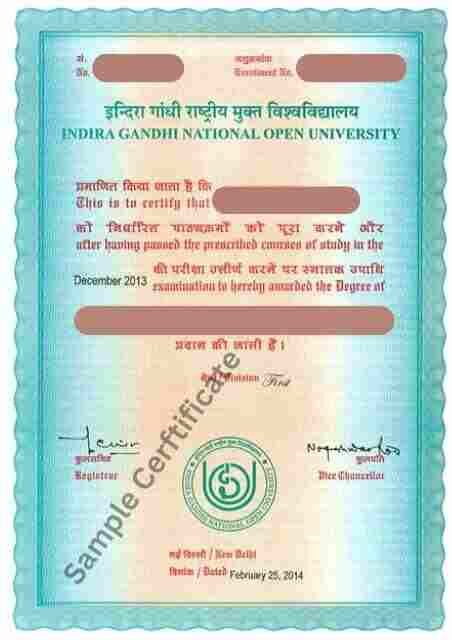
Sample Certificate of IGNOU
- Same online Doctorate/other degree as On Campus –Receive the same world-class education and global recognition as on-campus doctorates without the need to relocate
- Ranked Globally by CEOWorld –Ranked 69th globally by CEOWorld Magazine in the Best Business Schools Ranking
- Shorter Time to Completion –An innovative curriculum design, inspired by global standards that helps you earn your Doctorate faster.
IGNOU Admission Process
Indira Gandhi National Open University (IGNOU) offers a flexible and largely online admission process for its undergraduate, postgraduate, diploma, and doctoral programs. Candidates can apply through the official portal from anywhere in India. Admission confirmation timelines may vary depending on course type and document verification.
Here is the admission process for IGNOU:
Step 1 – Online Registration & Application
- Visit the official IGNOU admission portal.
- Register as a new user using a valid email ID and mobile number.
- Log in and select your desired program (UG, PG, Diploma, or PhD).
- Fill out the online application form with personal, academic, and contact details.
- Upload required documents and submit the application.
Step 2 – Application Review
- The university reviews submitted details and uploaded documents.
- For merit-based programs, admission is processed directly.
- For PhD programs, candidates must qualify for the entrance exam and/or interview as per UGC norms.
Step 3 – Fee Payment
- Pay the program fee online via debit card, credit card, net banking, or UPI.
- Fee varies depending on the selected program and duration.
Step 4 – Document Verification
Upload the required documents during application:
- Personal: Photograph, signature, valid ID proof.
- Academic: Mark sheets and certificates of qualifying examinations.
- Additional (if applicable): Category certificate (SC/ST/OBC/EWS), experience certificate (for specific programs).
Ensure all documents are clear and in the prescribed format to avoid rejection.
Step 5 – Admission Confirmation
- After successful verification and fee payment, admission is confirmed.
- Students receive enrollment details and study material access through the IGNOU student portal.
- For distance programs, study materials are provided digitally and/or via regional centers.
Few seats left with offers Apply now or pay more later!
EMI & Financial Support of IGNOU
Indira Gandhi National Open University is committed to making higher education affordable and accessible to learners across India. With one of the lowest fee structures among Indian universities, IGNOU ensures that financial constraints do not become a barrier to academic growth.
- Highly affordable fee structure across all programmes, designed for students, working professionals, and learners from diverse economic backgrounds.
- Semester-wise / year-wise fee payment options available for most programmes, reducing the need for large upfront payments.
- Government scholarship schemes applicable for eligible categories such as SC/ST, OBC, PwD, and economically weaker sections (EWS).
- Fee reimbursement schemes supported by central and state government initiatives for eligible students.
- Education loan options available through banks for higher-value programmes like MBA, MCA, and professional courses.
- No heavy reliance on EMI structures due to already subsidised tuition fees, making programmes financially manageable without long-term debt.
- Transparent fee policies with clearly defined payment guidelines available through the official university portal.
- Flexible learning model allows students to continue working while studying, enabling self-funded education.
For guidance on programme fees, scholarships, and eligibility for financial assistance, explore the official IGNOU portal or consult academic advisors.
Emi Partners







Don’t Let Fees Delay Your Goals
Seats are filling fast, don’t lose yours over fees. Apply for EMI now and lock your admission today.
Scholarships of IGNOU
IGNOU’s scholarship ecosystem is multi-layered, combining IGNOU’s own fellowship schemes for research students, Government of India NSP scholarships for reserved categories and economically weaker sections, state government reimbursement schemes, and multiple specialised fellowships. The result is a framework in which a large proportion of IGNOU’s student base can study at dramatically reduced or zero net cost.
1) SC/ST Students – Students from Scheduled Caste (SC) and Scheduled Tribe (ST) categories can receive a complete fee waiver for undergraduate and postgraduate programmes, meaning zero net programme cost. This waiver is among the most significant scholarship mechanisms available in Indian higher education: a BA, MA, MCom, or BSc from IGNOU, fully UGC-recognised, NAAC A++ accredited at zero cost for SC/ST students. Application via IGNOU Regional Centre and/or NSP portal (scholarships.gov.in).
2) National Scholarship Portal (NSP) – All IGNOU students from SC/ST/OBC/EWS/Minority/PWD backgrounds with family income below ₹3 Lakhs/year are encouraged to register at scholarships.gov.in immediately after admission confirmation. The NSP provides access to: Post-Matric Scholarship for SC students (Ministry of Social Justice), Post-Matric Scholarship for ST students (Ministry of Tribal Affairs), Post-Matric Scholarship for OBC students, Scholarships for Minorities (National Foundation for Communal Harmony), Central Sector Scholarship for EWS students, and National Fellowship for Persons with Disabilities.
3) IGNOU Special Scholarships – IGNOU offers its own institutional scholarships specifically for: SC students (National Fellowship for Scheduled Castes), ST students (National Fellowship for Scheduled Tribes), OBC students (National Fellowship for Other Backward Classes), PWD students (National Fellowship for Persons with Disabilities), and Women students (National Fellowship for Women). Each fellowship covers tuition fees and related expenses for UG and PG programme duration.
4) IGNOU PhD / Research Scholarship– PhD scholars at IGNOU in PhD programmes receive direct financial support: M.Phil scholars receive ₹5,000/month; PhD scholars receive ₹8,000/month. This is IGNOU’s internal research scholarship, separate from CSIR/UGC/ICMR/DBT national fellowships for which IGNOU PhD students can also apply through standard channels.
5) NCPEDP Scholarship – The National Centre for Promotion of Employment of Disabled People provides postgraduate scholarships to eligible IGNOU students with partial or complete disability. Application via NCPEDP website with proof of disability and IGNOU admission.
6) State Government Scholarship/Reimbursement Schemes – Every state government has its own post-matric scholarship or fee reimbursement scheme for reserved category students. States including Uttar Pradesh, Bihar, West Bengal, Maharashtra, Tamil Nadu, Karnataka, and others provide state funds to IGNOU students through their Social Welfare Departments. Students submit their IGNOU admission proof, caste certificate, and academic transcripts to the Social Welfare Officer of their state/district for processing. Reimbursement covers partial or full fee amounts depending on category and state policy.
7) UGC/MHRD Research and PG Scholarships– IGNOU students pursuing PG and PhD programmes qualify for UGC and MHRD research scholarships available to students from SC, ST, Minority, PwD, and OBC categories including UGC Non-NET Fellowships for master’s students and UGC-JRF / CSIR-JRF for PhD students. IGNOU’s NAAC A++ accreditation and Central University status ensure full eligibility.
8) Agriculture Programme Concession – 50% fee concession for rural students admitted to Agriculture Diploma and Certificate programmes (DCA, CCP, etc.) on production of domicile certificate. 50% concession for urban BPL students on production of income certificate.
9) Dr. Ambedkar Foundation Scholarship– Under the MoU with the Dr. Ambedkar Foundation (Ministry of Social Justice and Empowerment), SC/ST civil service aspirants enrolled in IGNOU’s relevant programmes can access training support for civil services examination preparation.
10) IGNOU Alumni Association Scholarships (Regional and Chapter Level)– Several IGNOU Regional Alumni Chapters provide merit and need-based scholarships at the regional level amounts and eligibility varying by chapter. Students should contact their Regional Centre for locally available alumni scholarship opportunities.
IGNOU Latest News/Updates
UGCs Academic Collaboration between Indian and Foreign Higher Education Institutions to offer Twinning Programme, Joint Degree, Dual Degree and Regulations, 2022, Click here to know!
Prohibited Courses or Programmes in Online mode, Click here to know!
A degree obtained through ODL mode is equivalent to a traditional degree, Click here to know!
According to the latest UGC guidelines, all candidates must create their ABC ID and DEB ID to get admission.Click here to Know more!
What is Academic Bank of Credit (ABC) Notification by UGC? Must Watch!
Precautions to be taken by the students before enrolling for programs offered under ODL & Online Learning Mode, Click here to know!
UGC declares a 100% Fee Refund policy for students within a specified period by universities.Click here to read the full notice.
Latest @Open & Distance Learning. Click here to view all.
Latest @Online Learning. Click here to view all.
IGNOU Learning Advantages

Study Anytime, Anywhere
100% Flexible Online Learning – Study anytime, anywhere at your own pace

Industry-Relevant Curriculum
Industry-Relevant Curriculum designed with real-world case studies

Affordable Tuition Fees
Affordable Tuition Fees compared to traditional European universities

Global Standards of Education
Globally Recognized Swiss Education Model with practical business focus

Career & Networking Support
Access to global alumni network, career mentoring, and professional development guidance.

Digital Learning Resources 24/7
Access to Recorded Lectures & Digital Learning Resources 24/7
IGNOU LMS & Study Materials
IGNOU’s learning delivery infrastructure is the most extensive and multi-modal of any Indian university designed to reach students regardless of location, bandwidth, age, disability, or prior educational experience.
1) Self-Learning Materials (SLMs) – SLMs for each course are written by subject experts, peer-reviewed, and updated regularly. Print SLMs are dispatched to registered students’ addresses. Digital SLMs are freely available to all users. IGNOU students and the general public on eGyanKosh (egyankosh.ac.in), India’s largest national digital repository for ODL study materials. Audiobooks are now available for management course SLMs. Promotional and learning materials are recorded in 23 regional languages for MBA and other programmes.
2) eGyanKosh – eGyanKosh (egyankosh.ac.in) is IGNOU’s national digital repository hosting SLMs, audio-video content, digital lectures, project reports, and research publications for all IGNOU programmes. Access is free and open to the public making IGNOU’s educational content a global public good accessible to anyone with internet access, not just enrolled students.
3) IGNOU Own LMS (Learning Management System) – IGNOU’s Centre for Online Education (COE) operates its own LMS for the 45 fully online academic programmes delivered through ignouiop.samarth.edu.in. The LMS provides: video lectures, recorded classes, discussion forums, assignment submission, quiz-based assessment, grade management, and student-teacher interaction. The COE vision is to make IGNOU a global leader in digital learning aligning with national digital initiatives (Digital India, NEP 2020) to provide learning anytime, anywhere.
4) Gyan Darshan – Gyan Darshan is IGNOU’s dedicated educational television infrastructure with four 24-hour channels broadcast from the audio-video production studios at IGNOU’s Maidan Garhi HQ. Content covers curriculum subjects, skill development, women’s empowerment, sustainable living, career guidance, science and technology, and cultural programming. The channels are accessible via DTH and cable across India reaching students in areas with no or intermittent internet.
5) Gyan Vani – Gyan Vani is IGNOU’s FM radio education network 26 channels across India broadcasting educational content for curriculum subjects and general knowledge. Radio reaches students in the most remote areas of India (including tribal areas, deserts, mountains, and islands) where internet infrastructure is absent and television reception is poor. This remains a meaningful delivery channel for India’s hundreds of millions of rural learners.
6) SWAYAM and SWAYAM PRABHA– IGNOU hosts multiple courses on SWAYAM (Study Webs of Active Learning for Young Aspiring Minds). India’s national MOOC platform and broadcasts on SWAYAM PRABHA educational channels. IGNOU students can use SWAYAM credits toward their programme completion under NEP 2020’s credit transfer and ABC (Academic Bank of Credits) provisions.
7) SAKSHAT Portal– The SAKSHAT portal (launched 2006 by President A.P.J. Abdul Kalam) provides a one-stop knowledge access platform for IGNOU students resources, links to SLMs, video content, and subject-specific digital materials.
8) Samarth Portal – All IGNOU admissions, re-registrations, exam form submissions, assignment status checks, grade card downloads, and fee payments are managed through the Samarth portal: ignouadmission.samarth.edu.in (ODL) and ignouiop.samarth.edu.in (Online). Students can track admission status, download study material dispatch updates, and manage all academic records digitally.
9) Study Centres – The 2,667+ Learner Support Centres across India provide face-to-face academic counselling sessions typically held on weekends for working professionals. These sessions are conducted by academic counsellors from conventional colleges and universities (33,212 counsellors nationally) and supplement the self-study materials. Attendance at counselling sessions is generally not compulsory but strongly recommended for complex subjects requiring discussion and problem-solving.
10) Central Library- IGNOU’s Central Library in New Delhi holds the largest collection of books, journals, and materials in the field of Distance Education in India established in 1986. The collection includes regular academic volumes, distance education research journals, IGNOU SLMs in archive, PhD theses, and digital databases. Remote access is available to enrolled students. Regional Centres maintain smaller reference libraries for learners who visit in person.
11) Audio-Video Production Studios– IGNOU’s Maidan Garhi HQ houses high-quality audio and video recording studios used to produce all Gyan Darshan television content, Gyan Vani radio programmes, video lectures for online programmes, and promotional materials. These studios run production operations that support both the 4 TV 1) channels and the 26 radio stations in near-continuous content creation.
12) Term End Examination (TEE) Infrastructure– TEE is held twice yearly (June and December) at designated examination centres across all 69 Regional Centre jurisdictions. For the July 2025 session: 578 courses were available in Computer-Based Test (CBT) format; 69 courses in Hybrid mode. The move toward CBT reduces geographic barriers for examination access and accelerates result declaration.
IGNOU Examination Pattern
IGNOU’s evaluation system combines continuous assessment (assignments) with terminal examinations (TEE) – a framework designed for students who study independently over weeks and months rather than attending daily lectures.
1) Assignments – For every enrolled course, students must submit one or more assignments before being eligible to appear in the TEE. Assignments are typically written responses to questions set in the assignment booklet for each course, essay-type, problem-solving, case analysis, or practical exercises depending on the subject. Assignments carry 30% weightage in the final grade for most programmes. They are submitted to the Learner Support Centre coordinator or uploaded digitally (for online programmes). Assignment submission deadlines (typically 30 September for December TEE, 30 March for June TEE) must be met failure to submit makes the student ineligible for that examination sitting. Solved assignments are available through official IGNOU channels and academic counsellors.
2) Term End Examination (TEE) 70% Weightage– TEE is the primary terminal evaluation a formal written examination held twice annually:
- June TEE: for students registered in January session
- December TEE: for students registered in July session Examination centres are spread across all 69 Regional Centre jurisdictions students choose an exam centre within their region at the time of exam form submission (exam form submission is a separate annual process from admission). TEE format: 3-hour written examinations for theory courses, structured answer papers. Passing marks: 40% in each course (35% in some programmes). Minimum marks in assignment and TEE individually required (even if combined average passes minimum component-wise performance needed).
3) Computer-Based Testing (CBT) Online Programmes and Select ODL Courses IGNOU has been rapidly expanding CBT for both its 45 online programmes and select ODL courses. For July 2025 session: 578 courses offered in CBT format (objective, short answer, or mixed). CBT is conducted at designated examination centres not from home. For online programmes, the examination infrastructure is integrated into the LMS or conducted at regional test centres. CBT enables faster result declaration and reduces traditional pen-and-paper logistics.
4) Practical and Project Evaluations– Many IGNOU programmes include practical or project components, laboratory work (science and engineering), field projects (social work, agriculture, education), clinical observations (health sciences, nursing), and project reports (management, computer science). These are evaluated by academic counsellors at study centres or at designated practical centres with specialised infrastructure. B.Ed and M.Ed programmes include Teaching Practice evaluated by school-based supervisors. Health sciences programmes include clinical placements assessed by medical/nursing supervisors.
5) OPENMAT MBA Entrance – Until 2022, IGNOU conducted the OPENMAT entrance examination for MBA and PhD admissions. As of 2023, OPENMAT was discontinued — MBA admissions are now based on direct application merit, making IGNOU MBA accessible without a separate entrance examination requirement.
6) PhD Entrance Test– IGNOU conducts a PhD Entrance Test for doctoral admissions held typically in January (January 5, 2026 for the 2025 cycle). The test assesses research aptitude, subject knowledge, and analytical ability. Candidates clearing the entrance test proceed to research proposal submission and supervisor allocation.
7) Flexible Examination Attempts– IGNOU’s examination flexibility is unmatched in India: students have maximum 6 years to complete a 3-year bachelor’s degree and 4 years to complete a 2-year master’s programme. Students who fail any course can re-appear in subsequent TEE sittings without losing their programme registration. Students can also improve previous pass marks by re-appearing in TEE, the higher score is counted. This multiple-attempt, maximum-duration flexibility is structurally designed to ensure no student is permanently failed out of the system.
8) Online Programme Assessment LMS-Integrated– For IGNOU’s 45 online programmes delivered via the COE LMS, assessment includes: weekly quizzes, graded discussion forums, auto-graded assignments, peer-assessed projects, proctored online examinations (or CBT at centre), and final project/thesis for postgraduate programmes. The online programme assessment framework is more continuous and LMS-embedded than the traditional ODL assignment+TEE structure — better suited for learners with regular internet access.
9) Grading and Results– IGNOU uses a letter grade and percentage system. Grade cards are published on the IGNOU result portal (ignou.ac.in/result) after each TEE cycle. Students can check marks and grades online. Grade disputes and re-evaluation applications are processed through Regional Centres. All results are linked to the enrolment number accessible throughout the programme duration.
IGNOU Career Scope, Placement & Salary — Role Wise
IGNOU graduates pursue careers across the full spectrum of Indian professional life. The salary ranges reflect the diversity of IGNOU’s student base from those entering government service at the start of their careers, to working professionals whose IGNOU qualifications accelerate promotions, to homemakers returning to professional life with newly acquired credentials.
Government Services (Largest Career Track for IGNOU Graduates)
| Role | Annual Salary (INR) |
| IAS/IPS/IFS (after UPSC, any graduate eligible) | ₹7.5L–18L + allowances (Grade Pay 5400–7600) |
| State PCS / SDM / DSP level | ₹6L–14L + allowances |
| Bank PO (IBPS/SBI) | ₹8.5L–12L (CTC) |
| SSC CGL Group B | ₹6.5L–10L |
| Defence Officer (after degree) | ₹7L–14L (depending on rank and service) |
| Railway Group B/C | ₹5.5L–9L |
| State Government Teacher (after BEd) | ₹4.5L–9L (varies by state/grade) |
| Junior Engineer (after BTech/BE — IGNOU SOET) | ₹4.5L–8L (govt.) |
Education and Teaching
| Role | Annual Salary (INR) |
| Primary/Secondary School Teacher (BEd qualified) | ₹4.5L–9L (govt.) |
| College Lecturer / Assistant Professor (MA/MSc + NET) | ₹12L–22L (govt. college) |
| School Principal (MEd + experience) | ₹8L–18L |
| Academic Counsellor (IGNOU itself) | ₹3L–6L (part-time, per session) |
| Distance Education Administrator | ₹5L–12L |
IT and Computer Science (BCA / MCA Track)
| Role | Annual Salary (INR) |
| Junior Software Developer (BCA — Entry) | ₹3L–7L |
| Software Developer (MCA — Entry) | ₹4L–10L |
| Data Analyst / Business Analyst (MCA) | ₹5L–12L |
| Systems Administrator / Network Engineer | ₹4L–10L |
| Senior Software Engineer (5+ yrs) | ₹10L–22L |
| IT Project Manager (8+ yrs) | ₹14L–30L |
| IGNOU MCA → AICTE-equivalent → Govt IT jobs | PSU/Govt ₹6L–15L |
Management and Business (MBA Track)
| Role | Annual Salary (INR) |
| Management Trainee / Junior Manager | ₹4L–10L |
| Operations / Supply Chain Manager (3–5 yrs) | ₹7L–16L |
| HR Manager / Business Development Manager | ₹6L–15L |
| Branch Manager (Banking — after JAIIB/CAIIB + MBA) | ₹8L–18L |
| Senior Manager / AVP (8+ yrs) | ₹14L–32L |
| Working Professional Promotion Benefit of IGNOU MBA | Salary increment ₹1L–5L/year typically upon credential upgrade |
Journalism and Media (SOJNMS)
| Role | Annual Salary (INR) |
| Reporter / Copy Editor (Entry) | ₹3L–7L |
| Digital Content Writer / Web Editor | ₹3.5L–8L |
| Senior Journalist / Sub-Editor (5+ yrs) | ₹7L–16L |
| Media Producer / Programme Head | ₹10L–25L |
Social Work (MSW Track)
| Role | Annual Salary (INR) |
| Social Worker / Programme Officer (NGO) | ₹3L–8L |
| CSR Programme Manager | ₹6L–15L |
| Government Welfare Programme Officer | ₹5L–10L (central/state) |
| IRDP / MNREGA Field Officer | ₹3.5L–6L |
Health Sciences and Nursing
| Role | Annual Salary (INR) |
| Hospital Administrator (PGDHA) | ₹5L–14L |
| Community Health Worker / ASHA Trainer | ₹2.5L–6L |
| Public Health Programme Officer | ₹4L–10L |
| Nursing Supervisor (after PB BSc Nursing) | ₹5L–12L |
Tourism and Hospitality (SOTHSM)
| Role | Annual Salary (INR) |
| Travel Consultant / Tour Manager | ₹3L–8L |
| Hotel Manager (after DTHM/PGDTHM) | ₹4L–12L |
| Tourism Development Officer (Govt.) | ₹5L–10L |
Research and Academia (PhD Track)
| Role | Average Annual Salary (INR) |
| University Professor / Academic | ₹10 – ₹28 LPA |
| Senior Corporate Consultant | ₹20 – ₹55 LPA |
| C-Suite Executive / Director | ₹35 – ₹90 LPA |
| Research Fellow / Policy Analyst | ₹12 – ₹30 LPA |
| AI & Business Strategy Advisor | ₹25 – ₹60 LPA |
Entrepreneurship and Self-Employment
| Category | Notes |
| Rural Entrepreneurs (Agriculture/Vocational programmes) | Income varies; IGNOU credentials support Mudra Yojana loan eligibility, govt MSME schemes |
| Working Professionals with IGNOU Certificates | Immediate salary/promotion benefits in current employment |
| Freelance Translators (SOTST graduates) | ₹3L–12L |
| Legal Aid Practitioners (SOL graduates) | ₹3L–10L |
IGNOU Placement Partners & Career Scope
IGNOU’s relationship with placement is fundamentally different from residential universities, and must be understood on its own terms. The majority of IGNOU’s 3+ million students are not seeking first employment: they are working professionals who are upgrading qualifications while already employed, homemakers returning to education, defence/government employees seeking additional credentials, or rural and semi-urban students pursuing first-generation degrees for government examination eligibility. The direct “campus placement” model relevant for IITs and IIMs applies to a small subset of IGNOU’s student body.
Campus Placement Cell (CPC)– IGNOU has a Campus Placement Cell (CPC) headquartered at its Delhi and Noida campuses. The CPC operates primarily online, broadcasting virtual and city-specific internship and placement drive opportunities to enrolled students across the country. An employer registration portal allows screened companies to post opportunities directly to relevant departments/schools. The CPC’s placement reach is national rather than geographically concentrated at one campus.
1) Previous Placement Drives– IGNOU has conducted campus placement drives at the Baba Saheb Ambedkar Convention Centre, Maidan Garhi with recruiters for roles including Customer Service Executives, Copy Editors, and Technical Writers, drawing from the humanities, social sciences, management, journalism, and computer science schools. Government sector, banking, publishing, media, and IT services are primary sectors represented.
2) Primary Career Pathways, Sector Wise– Given IGNOU’s student base, the most common career pathways are:
- Government Sector: Civil Services (IAS/IPS/IFS/IRS), State PCS, Banking (IBPS/SBI), Railways, SSC, Defence services, IGNOU degrees are valid for all central and state government examination eligibility
- Teaching: School and college teaching (particularly for BEd, MEd, BA/MA holders in education-eligible disciplines)
- IT and Computer Science: BCA and MCA graduates enter IT services, software development, and data roles, with AICTE-recognised MCA from IGNOU accepted at par with full-time MCA
- Management: MBA graduates enter banking, retail, operations, supply chain, and SME management roles
- Journalism and Media: SOJNMS graduates enter print, digital, and broadcast media
- Social Work and Development Sector: MSW graduates enter NGOs, government welfare programmes, CSR roles
- Healthcare: Health sciences, nursing, and public health programmes feed into hospital administration, community health worker roles, ASHA/ANM and similar government health employment
- Tourism and Hospitality: SOTHSM programmes feed hotel, travel agency, and tourism administration roles
- Agriculture: SOA programmes support agricultural extension worker and agri-business roles, particularly in rural India
- Law: SOL programmes support legal careers and judicial services aspirants
- Entrepreneurship: Working professionals with IGNOU management or vocational qualifications apply learning directly to business management











Live Placement Updates Are Rolling In!
Learners from recent batches are already getting shortlisted by hiring partners. Don’t miss your chance to be part of the next success story.
IGNOU Important Links
| Alumni Portal – 1 Link here | Know Your Status – 2 Link here |
| Convocation – 3 Link here | Reevaluation – 4 Link here |
| Convocation – 3 Link here | Reevaluation – 4 Link here |
| Convocation – 3 Link here | Reevaluation – 4 Link here |
| Convocation – 3 Link here | Reevaluation – 4 Link here |
IGNOU Geneva Address
IGNOU Address
Indira Gandhi National Open University (IGNOU)
Maidan Garhi, Chhatarpur, New Delhi, Delhi 110068
Are you ready to take the next step in your career ?
Frequently Asked Questions About IGNOU
What is IGNOU and why is it described as the world's largest university?
IGNOU (Indira Gandhi National Open University) is a public open and distance learning university established by Act of Parliament on 20 September 1985, named after Prime Minister Indira Gandhi. It is headquartered at Maidan Garhi, New Delhi. It is the world’s largest university by active enrolment, over 3 million students simultaneously enrolled, and has cumulatively served over 40 million learners since 1989. It is ranked #1 Open University by NIRF 2025, holds NAAC A++ accreditation (first open university in India to receive the highest grade), and is recognised as a Central University by UGC with degrees equivalent to all other Indian universities. It operates through 21 Schools of Studies, 69 Regional Centres, 2,667+ Learner Support Centres across India, and 25 Overseas Study Centres in 15 countries. Its scale derives from its institutional mission: flexible, affordable, accessible education for every Indian who wants it , regardless of age, location, income, or prior educational disruptions.
Are IGNOU degrees valid and equivalent to degrees from regular universities?
Yes, completely and without qualification. UGC formally recognised IGNOU degrees as equivalent to those of all AIU member universities in 1992, a recognition that has been consistently upheld. The Supreme Court of India has confirmed IGNOU degree validity in multiple judgments. AICTE specifically recognises IGNOU’s MBA and MCA. Government of India central employment, PSU recruitment, UPSC, all state PSC examinations, IBPS/SBI banking examinations, school/college teaching eligibility (TGT, PGT, NET, PhD admissions), and private sector employment, all accept IGNOU degrees on identical terms to degrees from DU, BU, MU, or any other accredited Indian university. The only programmes IGNOU does not offer in ODL mode — per UGC and AICTE guidelines are certain clinical/professional programmes (e.g., LLB) where physical presence is mandated; all other programmes are fully valid.
What programmes does IGNOU offer and which are most popular?
IGNOU offers 325 programmes across 21 Schools of Studies- the most comprehensive academic portfolio of any single Indian university. These span: Certificate programmes (3–6 months), Diploma and Advanced Diploma (1–2 years), Bachelor’s degrees including BA/BCom/BSc/BCA/BBA/BSW/BEd/BLIS and FYUPs under NEP 2020 (3–4 years), Master’s degrees including MA/MCom/MSc/MBA/MCA/MSW/MEd/MLIS (2–3 years), PG Diplomas and Certificates (1 year), and PhD (minimum 3 years). Most popular programmes: BAG (Bachelor of Arts General) with 109,840 registrations in 2023-24; MBA (recognised by AICTE, ₹64,000 total for 2 years); MCA (AICTE-recognised, ₹50,800 for 3 years); BCA (₹46,200 for 3 years); MA (7,500–25,200 per programme); MCom (₹19,000 for 2 years); BEd (₹55,000 for 2 years). IGNOU also offers 44 online programmes (increasing to 45+) including fully online MBA, MCA, and BA/BSc specialisations — delivered via its own LMS without any requirement to visit a study centre.
How does admission work at IGNOU and when are sessions?
IGNOU offers admissions in two sessions annually. January session: fresh registration typically opens in November and closes in January (check ignou.ac.in for exact dates). July session: fresh registration typically opens in May and closes in July. Re-registration (for continuing students) follows similar timelines per session. Most programmes admit in both sessions; some (BEd, PhD, select professional programmes) admit once annually. Most UG and PG ODL programmes have no entrance examination, admission is merit-based on previous qualification. Programmes requiring entrance: PhD (IGNOU PhD Entrance Test), BEd (BEd Entrance Test), and select health sciences programmes. The online MBA (since 2023) and distance MBA no longer require OPENMAT , direct application. Apply at: ignouadmission.samarth.edu.in (ODL) or ignouiop.samarth.edu.in (Online). Registration fee: ₹300 (general) to ₹1,000 (PhD/BEd).
What are the fees at IGNOU and is financial support available?
IGNOU is the most affordable Central University in India. Representative fees: BAG (BA General, 3 years) ₹13,200 total; MA ₹7,500–25,200 total (2 years); MCom ₹19,000 total; MBA ₹64,000 total (2 years, ODL) / ₹58,000 (Online); MCA ₹50,800 total (3 years); BCA ₹46,200 (3 years); BEd ₹55,000 (2 years); Diploma programmes ₹3,000–15,900; Certificate programmes ₹900–4,000. Additional: registration fee ₹300 (one-time), re-registration ₹300/year, TEE examination ₹200/course. No hostel/residential costs for ODL students. Financial support: SC/ST students can get full fee waiver via IGNOU Regional Centre + NSP. OBC/EWS/PWD/Minority students access NSP scholarships at scholarships.gov.in (family income ≤₹3L). State governments provide reimbursement through Social Welfare Departments. Agriculture programme rural students: 50% fee concession. IGNOU PhD scholars: ₹8,000/month. Agriculture Diploma rural students: 50% waiver with domicile certificate.
What is eGyanKosh and how do students access study materials?
eGyanKosh (egyankosh.ac.in) is IGNOU’s national digital repository , hosting Self-Learning Materials (SLMs, i.e., textbooks written specifically for distance learners) for all IGNOU courses, audio-video programmes, digital lectures, and research publications. It is free and open to the public, any person in the world can download IGNOU’s study materials without being enrolled. Enrolled students also receive printed SLMs dispatched to their registered address (included in programme fee). Digital delivery via eGyanKosh and the COE LMS is available for all programmes. Students use the Samarth portal (ignouadmission.samarth.edu.in) for admission, exam form submission, status tracking, and fee payment. Results are available at ignou.ac.in/result. Study material dispatch status is trackable at ignou.ac.in. Gyan Darshan TV (4 channels) and Gyan Vani FM radio (26 channels) provide supplementary curriculum content for students without internet- making IGNOU possibly the only university in the world that teaches simultaneously via television, radio, print, and internet.
What is IGNOU's examination system and how many attempts are allowed?
IGNOU uses a combination of continuous assessment (assignments- 30% weightage) and Term End Examination (TEE- 70% weightage). TEE is held twice annually: June (for January session students) and December (for July session students). Assignments must be submitted before TEE eligibility. Students who fail can re-appear in any subsequent TEE sitting. Students who pass but want to improve marks can re-appear. Maximum programme duration: 6 years for a 3-year bachelor’s degree, 4 years for a 2-year master’s degree, giving significant flexibility for part-time learners. Examination centres are in all 69 Regional Centre jurisdictions, students choose their nearest exam centre. Computer-Based Testing (CBT) is now available for 578 courses (July 2025). For online programmes, examinations are conducted via the LMS or at CBT centres.
Does IGNOU help with placements and career support?
IGNOU has a Campus Placement Cell (CPC) at its Delhi and Noida campuses , primarily operating online to reach students across India. The CPC lists virtual and city-specific placement drives, internship opportunities, and employer registrations , particularly for roles in IT services, media, management, and public sector. It is important to understand IGNOU’s placement context: most of the 3 million students are already employed and studying for qualification upgrades or promotions, not seeking first employment via campus placement. For new graduates seeking first employment, career pathways depend heavily on the programme: BCA/MCA graduates compete in IT sector placements; MBA graduates enter management trainee roles; BEd/MEd graduates appear for government teacher recruitment; law graduates appear for DLSA/bar examination eligibility. Government sector examination eligibility , UPSC, state PSC, IBPS, SBI, SSC, railways, defence , is the single largest career enabler for IGNOU graduates, and for this the IGNOU degree is completely equivalent to any other degree.
How does IGNOU serve special populations - women, prisoners, military personnel, rural communities, international students?
IGNOU specifically designs its network to reach populations that conventional universities structurally exclude. Prison study centres: IGNOU has established study centres inside prisons across India , providing undergraduate and postgraduate education to incarcerated persons, the only Indian university to do so at scale. Military station study centres: IGNOU study centres at Indian Army, Navy, and Air Force stations allow defence personnel to pursue degrees without disrupting active service. Women-focused centres: IGNOU has established study centres in low-female-literacy districts specifically targeting women who cannot travel to distant conventional universities.
How do I apply and what are the key contacts?
Fresh admission (both ODL and Online): Apply at ignouadmission.samarth.edu.in (ODL) or ignouiop.samarth.edu.in (Online programmes). Check ignou.ac.in for current session dates, typically January session opens in November, July session opens in May. Re-registration (continuing students): same Samarth portals, ₹300 per year/semester. PhD admission: ignou.ac.in , PhD Entrance Test held annually in January. Examination form: ignou.ac.in/exam , submit separately before each TEE. Results: ignou.ac.in/result. Study material: egyankosh.ac.in (free) or Samarth portal for dispatch tracking. Scholarship: scholarships.gov.in (NSP) for SC/ST/OBC/EWS/PWD/Minority.