

IGNOU PhD Anthropology
325,000+ Degrees Conferred (2026) | 21 Schools of Study | 67 Regional Centres
Home >> IGNOU >> PhD Doctorate >> Anthropology
IGNOU (Indira Gandhi National Open University) offers a Doctor of Philosophy (PhD) in Anthropology under its School of Social Sciences (SOSS), with the programme code PHDAN. This is the highest academic qualification in the discipline of Anthropology in India, designed to train scholars in rigorous, original research that advances human understanding across socio-cultural, biological, archaeological, and applied dimensions.
- Accreditation: NAAC A++ | UGC | AICTE | AIU | NIRF
- Courses for Working Professionals
- Study Mode: Full-Time/Part Time
- Network Building & Alumni Connects
- EMI Options: You’ll have access to budget-friendly payment plans
- Last date of admission: OnGoing
This information is provided for audience reference only. The video has been sourced from YouTube as a free resource. We are not affiliated with the YouTube channel or its creators. The views and opinions expressed in the video are their own.
Learn From Top Ranked Doctorate Institutes & Universities




 Latest Updates
According to British Council, At the postgraduate level (which feeds into PhD admissions), Social Sciences holds the largest share of students at 18.6%, followed very closely by Management at 18.2%, then Science (15.1%), Indian Languages (7.9%), and Commerce (7.8%).
About IGNOU University PhD Anthropology Programs
IGNOU PhD in Anthropology (PHDAN) programme is offered under SOSS, IGNOU’s largest and oldest school, established in 1986, which encompasses eight disciplines: Anthropology, Economics, History, Library & Information Science, Political Science, Public Administration, Psychology, and Sociology. This rich interdisciplinary ecosystem gives PhD Anthropology scholars unique cross-disciplinary research opportunities that are rare in India’s open and distance education landscape.
Anthropology at IGNOU approaches the study of the human species holistically- integrating physical, social, cultural, and archaeological perspectives to address contemporary bio-social, cultural, and environmental challenges. The programme is designed to produce professional researchers and academics who can apply anthropological insights in academic institutions, government bodies, NGOs, cultural organisations, policy research, UX research, and corporate social responsibility domains.
IGNOU PhD Anthropology programme is available in both Full-Time and Part-Time modes, making it accessible to working professionals, social researchers, museum curators, NGO workers, government officers, and field researchers who wish to earn a doctorate while continuing their careers. Medium of instruction is both English and Hindi- a significant advantage for scholars from Hindi-medium academic backgrounds.
The programme fully complies with UGC (Minimum Standards and Procedure for Award of PhD Degree) Regulations, 2022, and the degree is recognized by UGC, AIU, and WES, carrying the same legal standing as any PhD from a Central University of India.
Ranking & Approvals of IGNOU PhD Anthropology Programs

AACSB Member
IGNOU holds NAAC A++ grade - the highest accreditation grade available from the National Assessment and Accreditation Council.
UGC Recognition
IGNOU is recognised as a Central University by the University Grants Commission of India.
AIU Recognition
The Association of Indian Universities (AIU) recognises IGNOU degrees as equivalent to those conferred by its member universities - meaning the full equivalence applies across India's entire university membership.

NIRF Ranking
NIRF 2025 ranks IGNOU #1 in the Open Universities category - the top position in its class.
Build the Right Skills & Shape Your Future from Our Unbiased Career Counselling. Choose the right path and Get 100 % Unbiased Career Advice.
Claim Your 100% Free Guidance on 100+ Online Universities
Why Choose IGNOU PhD Anthropology Programs
UGC-Recognized & Highly Credible Degree
A PhD from Indira Gandhi National Open University (IGNOU) is fully recognized by UGC and holds strong credibility across academia, government, and research institutions. Being a central university with NAAC A++ accreditation, it ensures your doctorate is valid for Assistant Professor roles, research positions, and promotions.
Affordable PhD with Pan-India Accessibility
IGNOU offers one of the most affordable PhD programs in India, making doctoral education accessible to a wider audience. With its nationwide network of regional centres, candidates from any location can pursue research without relocating, reducing overall cost burden.
Flexible Research Structure for Working Professionals
The program is designed with a flexible and research-driven approach, allowing working professionals to balance career and academics. With guided supervision, periodic reviews, and blended support, learners can progress at their own pace while maintaining professional commitments.
IGNOU PhD Anthropology Key Facts & Advantages
- IGNOU is one of the very few universities in India to offer a PhD in Anthropology through the open and distance learning (ODL) system – combining the academic rigour of a regular doctorate with the accessibility of IGNOU’s platform.
- Available in English AND Hindi medium – unique among Indian central universities for doctoral-level Anthropology, making it accessible to Hindi-medium scholars from across India’s heartland states.
- Ranked #1 Open University in India by NIRF 2025 and accredited NAAC A++ – the IGNOU PHDAN degree carries full academic credibility recognised by universities, government, and international bodies.
- SOSS (School of Social Sciences) is IGNOU’s flagship and largest school – PhD Anthropology scholars benefit from cross-disciplinary synergies with researchers in Economics, Political Science, Public Administration, History, and Sociology.
- The programme covers all four major branches of Anthropology: Social-Cultural Anthropology, Biological/Physical Anthropology, Archaeological Anthropology, and Applied Anthropology – one of the broadest doctoral anthropology research platforms in India.
- Rigorous classroom training combined with fieldwork methodologies – scholars are equipped with both theoretical depth and practical competencies in anthropological data collection, analysis, and ethical field research.
- Interdisciplinary research encouraged – scholars can integrate insights from biology, ecology, history, economics, sociology, and public health into their anthropological research, guided by IGNOU’s cross-disciplinary faculty.
- Part-Time PhD track specifically designed for employed researchers, social workers, government officers, museum professionals, NGO workers, tribal welfare officers, and field anthropologists.
- After the mandatory 6-month face-to-face course work at IGNOU HQ, New Delhi, remaining research can be conducted with schedule flexibility under supervisor guidance – essential for professionals working in remote field locations.
- Minimum 3 years and maximum 6 years duration (up to 8 years for women and PwD scholars with 40%+ disability) – ample time to complete rigorous original fieldwork-based research.
- No hostel facility at IGNOU, but the Part-Time track ensures scholars can maintain their professional base while completing their doctorate.
- IGNOU PhD recognized by UGC-DEB, AIU, and WES (World Education Services) – the degree is accepted for academic employment and immigration purposes across India and internationally.
- Opens eligibility for UGC Assistant Professorship in Anthropology – the fastest route to faculty positions at central universities, state universities, IITs (Social Science departments), and autonomous anthropology research institutes.
- Internationally applicable in academia, cultural preservation, development organisations (UN, UNDP, UNICEF), museum curation, and corporate UX/consumer insights research.
- First-year programme fee of approximately ₹17,850 — one of the most affordable doctoral programmes in any discipline at any central university in India.
- IGNOU institutional fellowships — Dr. B.R. Ambedkar Fellowship (eligible male scholars) and Savitribai Phule Fellowship (eligible female scholars) — provide direct financial support to full-time researchers.
- UGC-JRF holders in Social Science / Anthropology receive ₹37,000–₹42,000/month as fellowship stipend, making the programme financially self-sustaining for NET-JRF qualified scholars.
- ICSSR (Indian Council of Social Science Research) Doctoral Fellowship available for social science scholars — one of the highest fellowships in humanities and social sciences research in India.
Course Highlights of IGNOU PhD Anthropology
| Parameter | Details |
| Programme Name | Doctor of Philosophy in Anthropology (PHDAN) |
| Offering School | School of Social Sciences (SOSS), IGNOU |
| Discipline | Anthropology |
| University | Indira Gandhi National Open University (IGNOU), New Delhi |
| Programme Code | PHDAN |
| Mode of Study | Regular (Face-to-face Coursework at IGNOU HQ, New Delhi) |
| Programme Type | Full-Time and Part-Time |
| Medium of Instruction | English & Hindi (Bilingual) |
| Minimum Duration | 3 Years (36 Months) |
| Maximum Duration | 6 Years (72 Months) |
| First Year Fee (Indian Students) | ₹17,850/- (Registration + Coursework + UDF) |
| Subsequent Year Fee | ₹8,400/- per year (Year 2 onwards) |
| Application Fee | ₹2,000/- (Non-refundable, July 2026 session) |
| Approvals & Recognition | UGC-DEB | AIU | NIRF #1 OU | WES | NAAC A++ |
| Admission Sessions | January & July (Bi-annual) |
| Programme Coordinators | Dr. Mitoo Das & Dr. K. Anil Kumar, SOSS, IGNOU |
| Application Portal | ignou-phd.samarth.edu.in |
| Total Seats (July 2026) | 9 (UR=4, SC=1, ST=1, OBC=2, EWS=1) |
| Minimum Attendance (Coursework) | 80% – Mandatory at IGNOU Campus, New Delhi |
| Institutional Fellowships | Dr. B.R. Ambedkar Fellowship (Male) | Savitribai Phule Fellowship (Female) |
| Unique Feature | Bilingual (English + Hindi) medium; covers all 4 branches of Anthropology |
IGNOU PhD Anthropology Programs Duration & Eligibility
- Masters in Anthropology- M.Sc. (Anthropology) or M.A. (Anthropology)- from a UGC-recognized university or equivalent institution. This is a specific eligibility requirement unique to PHDAN.
- Minimum aggregate of 55% marks (or equivalent grade on a point scale) in the qualifying postgraduate degree.
- Relaxation of 5% marks (i.e., 50% aggregate) for SC / ST / OBC (Non-Creamy Layer) / Differently-Abled / EWS candidates.
- A valid UGC-NET score in Anthropology (or Social Sciences) is required for Categories I, II, and III. Category IV candidates can appear for IGNOU’s University-level Entrance Test.
- Candidates with a 4-year / 8-semester bachelor’s degree with 75% marks (70% for reserved categories) are eligible for direct PhD admission per UGC Regulations 2022.
- M.Phil. degree holders in Anthropology with 55% marks (50% for reserved categories) are also eligible.
- Foreign university degree holders are eligible if their institution is accredited by a recognized statutory authority in their home country.
- Employed candidates must submit a No Objection Certificate (NOC) from their employer on the organisation’s letterhead, in the prescribed IGNOU format (Annexure IV), at the time of Interview/Viva-Voce.
Program Duration
- Minimum Duration: 3 Years (36 Months)
- Maximum Duration: 6 Years (72 Months)
- Women candidates and PwD candidates with 40%+ benchmark disability receive an additional 2-year extension beyond the maximum 6-year limit.
- Course Work conducted in the first 6 months at IGNOU HQ, New Delhi- 80% physical attendance is mandatory for all scholars.
- After the course work phase: independent original research, annual progress reporting to the Doctoral Research Committee (DRC), pre-submission seminar, thesis submission, and open viva-voce.
IGNOU PhD Other Specialization
| IGNOU PhD Other Specialization / Research Area | Duration |
|---|---|
| PhD in Education | 3 – 6 Years |
| PhD in English | 3 – 6 Years |
| PhD in Hindi | 3 – 6 Years |
| PhD in Sociology | 3 – 6 Years |
| PhD in Political Science | 3 – 6 Years |
| PhD in Public Administration | 3 – 6 Years |
| PhD in Economics | 3 – 6 Years |
| PhD in Commerce | 3 – 6 Years |
| PhD in History | 3 – 6 Years |
| PhD in Geography | 3 – 6 Years |
| PhD in Library & Information Science | 3 – 6 Years |
| PhD in Journalism & Mass Communication | 3 – 6 Years |
| PhD in Tourism Studies | 3 – 6 Years |
| PhD in Translation Studies | 3 – 6 Years |
| PhD in Gender & Development Studies | 3 – 6 Years |
| PhD in Social Work | 3 – 6 Years |
| PhD in Rural Development | 3 – 6 Years |
| PhD in Development Studies | 3 – 6 Years |
| PhD in Population Studies | 3 – 6 Years |
| PhD in Computer Science | 3 – 6 Years |
| PhD in Information Technology | 3 – 6 Years |
| PhD in Environmental Science | 3 – 6 Years |
| PhD in Interdisciplinary & Transdisciplinary Studies | 3 – 6 Years |
| PhD in Distance Education | 3 – 6 Years |
| PhD in Adult Education | 3 – 6 Years |
| PhD in Special Education | 3 – 6 Years |
| PhD in Agriculture Extension | 3 – 6 Years |
| PhD in Food & Nutrition | 3 – 6 Years |
| PhD in Home Science | 3 – 6 Years |
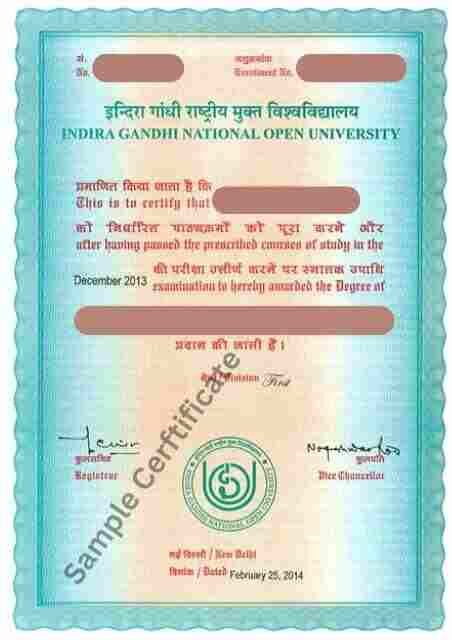
Sample Certificate of IGNOU PhD Programs
- Same online Doctorate/other degree as On Campus –Receive the same world-class education and global recognition as on-campus doctorates without the need to relocate
- Ranked Globally by CEOWorld –Ranked 69th globally by CEOWorld Magazine in the Best Business Schools Ranking
- Shorter Time to Completion –An innovative curriculum design, inspired by global standards that helps you earn your Doctorate faster.
IGNOU PhD Anthropology Admission Process
Indira Gandhi National Open University (IGNOU) offers a flexible and largely online admission process for PhD Anthropology doctoral programs. Candidates can apply through the official portal from anywhere in India. Admission confirmation timelines may vary depending on course type and document verification.
Here is the admission process for IGNOU:
- Step 1 – Visit the IGNOU PhD portal: https://ignou-phd.samarth.edu.in/ — Create your ABC ID and DEB ID (mandatory as per latest UGC guidelines) and complete the Samarth portal registration.
- Step 2 – Fill out the online PhD Admission Form selecting PHDAN (Anthropology). Category IV candidates should select ‘NOT APPLICABLE’ for the JRF option.
- Step 3 – Upload scanned copies of required documents: M.Sc./M.A. Anthropology marksheets, degree certificate, UGC-NET/JRF certificate (if applicable), valid photo ID (Aadhaar/Passport/Voter ID/Driving Licence), and NOC from employer (for Part-Time applicants).
- Step 4 – Pay the non-refundable application fee of ₹2,000/- via net banking, debit card, or credit card on the portal.
- Step 5 – If shortlisted, attend the Interview/Viva-Voce at IGNOU HQ, Maidan Garhi, New Delhi. Carry original valid photo ID. No TA/DA is provided for attending the interview.
- Step 6 – Final merit list is published on www.ignou.ac.in. No individual communication is sent – candidates must check the website regularly. Selected candidates receive offer letters.
- Step 7 – Complete admission formalities, pay first-year fees (₹17,850/-), and receive course work schedule for the mandatory 6-month face-to-face phase at IGNOU, New Delhi.
Admission Categories
- Category I – UGC-NET with JRF: Directly called for Interview/Viva-Voce. 100% weightage to interview performance. Highest preference in seat allocation — JRF scholars are prioritised.
- Category II – UGC-NET (Eligible for Assistant Professor & PhD): 70% weightage to NET score + 30% to Interview/Viva-Voce performance.
- Category III – UGC-NET (Eligible for PhD only): 70% weightage to NET score + 30% to Interview/Viva-Voce performance.
- Category IV – University-level Entrance Test: Must score minimum 50% in IGNOU’s entrance test (with applicable relaxation). 70% weightage to entrance test + 30% to Interview/Viva-Voce. Candidates shortlisted in 1:5 ratio against available seats.
Interview / Viva-Voce Evaluation Components
- Research Methodology – 40% (qualitative/quantitative methods, fieldwork ethics, anthropological data collection)
- Subject Domain Knowledge (Anthropology) – 40% (anthropological theories, sub-disciplines, area expertise)
- Communication Skills – 20% (research articulation, academic writing ability, field research experience)
Few seats left with offers Apply now or pay more later!
Job Roles After IGNOU PhD Anthropology Programs
Entry Level Leadership
- Research Assistant – Anthropology / Social Sciences
- Field Investigator (Tribal / Rural Studies)
- Junior Research Fellow (JRF)
- NGO Programme Associate
- Survey Research Assistant
- Documentation Officer (Cultural / Heritage Projects)
- Museum Assistant / Curatorial Assistant
- Data Analyst – Social Research Projects
- Teaching Assistant (University / College)
- UX Research Intern (Behavioral Studies)
Mid Level Leadership
- Assistant Professor (Anthropology / Sociology)
- Research Officer – Government / Think Tanks
- Anthropologist – Anthropological Survey of India (AnSI)
- Tribal Welfare Officer – State / Central Govt
- Social Impact Analyst – NGOs / International Organizations
- Archaeological Research Associate – ASI
- Museum Curator / Cultural Resource Manager
- Forensic Anthropologist – CFSL / Police
- Policy Research Analyst – Development Sector
- Consumer Behavior / UX Researcher – Corporate Sector
Senior Level Leadership
- Professor / Head of Department (Anthropology)
- Senior Scientist – Research Institutions
- Director – Tribal Research Institute
- Policy Advisor – Government / International Bodies
- Programme Director – UN / World Bank Projects
- Chief Anthropologist – Research Organizations
- Senior Consultant – Social Impact / Development
- Head of Research – NGOs / Think Tanks
- Corporate DEI (Diversity & Inclusion) Head
- Cultural Heritage Director / Museum Director
IGNOU PhD Anthropology Programs Curriculum (Syllabus/Subjects)
The IGNOU PhD in Anthropology (PHDAN) curriculum is structured in two phases: (1) structured face-to-face course work in Year 1 at IGNOU HQ, New Delhi, covering anthropological research methodology, theory, and ethics; and (2) independent original research leading to a thesis on a chosen topic in socio-cultural, biological, archaeological, or applied anthropology.
IGNOU PhD Anthropology Programs Curriculum
The pre-PhD coursework (first 6 months) is structured into 18 credits across 180 sessions and includes compulsory and elective components.
Compulsory Courses
| Course Code | Details |
| PAN1.1 |
Research Methodology in Anthropology Foundations of anthropological research design; qualitative methods (ethnography, participant observation, oral history, interview techniques); quantitative methods (biometric measurement, demographic analysis, statistical tools); fieldwork planning, data recording, and ethical protocols for research involving human subjects and tribal/indigenous communities. Type: Compulsory Credits: 4 Credits |
| PAN1.2 |
Research Skills, Ethics & Academic Writing in Anthropology Literature review methodologies for anthropological research; academic writing standards (AAA, APA citation formats); informed consent and research ethics with vulnerable populations; Indigenous data sovereignty principles; publication norms in anthropological journals; preparation of research proposals and field reports. Type: Compulsory Credits: 4 Credits |
| PAN1.3 |
Literature Review & Term Paper Systematic review of a minimum of 15 peer-reviewed anthropological research papers/monographs; preparation of a research term paper under the guidance of the assigned supervisor; identification of research gaps and formulation of the PhD research question. Type: Compulsory Credits: 4 Credits |
| RPE-001 |
Research and Publication Ethics Common workshop-mode course at IGNOU HQ covering plagiarism, intellectual property rights in research, ethical committees, data sharing norms, and ethical conduct in social and biological sciences research. Type: Compulsory Credits: 2 Credits |
| PAN1.4 |
Elective Domain Specialisation An advanced/PG-level course in the scholar’s chosen sub-discipline (e.g., Socio-Cultural Anthropology, Biological Anthropology, Archaeological Anthropology, Applied Anthropology, Tribal Studies, Medical Anthropology, Environmental Anthropology, Genetic Anthropology) – selected in consultation with the assigned supervisor. Type: Elective Credits: 4 Credits |
Key Research Specialisation Areas for Thesis (Indicative)
- Socio-Cultural Anthropology: Kinship and family structures, marriage systems, caste and tribal societies, religion and ritual, cultural change and globalisation
- Biological / Physical Anthropology: Human genetics, population genetics, skeletal biology, growth and development, forensic anthropology, paleoanthropology
- Archaeological Anthropology: Material culture analysis, prehistoric settlements, ethnoarchaeology, cultural resource management, heritage documentation
- Applied Anthropology: Tribal development, community health, displacement and rehabilitation, gender in tribal societies, educational anthropology
- Medical Anthropology: Health beliefs and practices, traditional healing, disease ecology, epidemiology in tribal communities, mental health across cultures
- Environmental Anthropology: Human-environment interactions, climate change and indigenous communities, ecological knowledge systems, natural resource management
- Genetic Anthropology & Genomics: Population structure, ancient DNA, molecular markers, human migration patterns, forensic DNA analysis
- Urban Anthropology: Migration and urbanisation, slum communities, identity and belonging, ethnic diversity in cities
- Tribal Studies & Indigenous Rights: Tribal policy, customary law, FNRIP (Free, Prior and Informed Consent), indigenous knowledge systems, PVTG communities
- Developmental Anthropology: Participatory development, NGO interventions, social impact assessment, displacement studies
Phase 2: Research & Thesis (Year 2 Onwards)
- Independent original research under assigned SOSS faculty supervisor, including fieldwork at approved sites
- Annual progress reports submitted to the Doctoral Research Committee (DRC); mandatory approval for continuation
- Pre-submission seminar: presentation of complete research findings before the DRC — feedback incorporated before final submission
- Thesis submission (minimum 3 years after enrolment); plagiarism check mandatory per UGC PhD Regulations 2022
- External thesis evaluation by 2+ independent examiners from reputed institutions appointed by IGNOU
- Open viva-voce: final oral defence before External Examiner and DRC
What is the Fees of an IGNOU PhD Anthropology Programs?
- Starting at INR 16,800*/year
- Program Fees : INR ₹53,550/ * (Full 3-year Programme)
*Note: Fees once paid are non-refundable. International students are not eligible for this programme. Exam fee is not included in the above structure.
The total fee structure for the IGNOU Phd Anthropology programs is INR 53,550/-, and this fee structure is uniform across all specializations/disciplines. The Ph.D. program consists of 6 semesters, with the total course price determined by the chosen specialization. IGNOU provides flexibility by allowing students to pay their tuition in installments or one big payment. International students can also enroll in the Ph.D program, however, their costs differ from those of Indian students. International students’ costs vary depending on specialization, dormitory fees, and other charges.
| IGNOU PhD Computer Science Fees Component | Amount (INR) |
| Registration & Coursework Fee (16 Credits – Year 1) | ₹16,800/- |
| Research and Publication Ethics – RPE-001 (Free Course) | ₹1,050/- (exam fee component) |
| University Development Fee | ₹200/- |
| Total First Year Fee | ₹18,050/- (All Inclusive) |
| Application Fee (Non-refundable) | ₹2,000/- |
| Total Fees for 3 Years | ₹53,550/- (Full 3-year Programme) |
Important Notes
– All fees are subject to change by the university and are non-refundable once paid.
– In case of extension beyond 3 years, annual fees continue to be charged as applicable.
– No separate fees are charged for library access, coursework materials, or lab usage (where applicable), unless otherwise notified by the school/discipline.
– For latest & updated information, you must visit IGNOU official website.
An Online DBA Is An Alternative to a Ph.D. Anthropology from IGNOU
The word DBA stands for Doctor of Business Administration, it’s an alternative to a PhD in Management program that focuses on advanced business principles, leadership abilities, and research methods. A DBA program, like a Ph.D., requires extensive study and research in business-related fields, but with a practical, real-world focus. DBA candidates frequently research themes such as organizational behavior, strategic management, entrepreneurship, and global business concerns. A DBA program aims to produce highly trained business professionals who can give significant insights into the business world via rigorous academic study and practical application.
IGNOU offers a Ph.D. program but the course takes time and that will be hard for working professionals to complete their Ph.D. degree along with their work and to ease this problem. Interested candidates can go for the Online DBA program which is offered by various reputed foreign universities and holds the same value and recognition as a regular Ph.D. degree. Here is the list of some of the universities that provide online DBA programs:
Top 5 Online Doctoral Degree Universities Fees Comparison
| University | Online Doctorate Fees | Global Accreditations |
| Rushford Online DBA Doctorate | INR 6,50,000* | AACSB | ACBSP | EDUQUA |
| ESGCI Online DBA Doctorate, Paris | INR 6,50,000* | ACBSP | IACBE |
| GGU Online DBA Doctorate | INR 10,65,000* | AACSB | WES |
| Edgewood Online DBA Doctorate | INR 9,50,000* | WES | HLC |
| SSBM Online DBA Doctorate | INR 7,50,000* | ACBSP | BAC | EDUQUA |
EMI & Financial Support of IGNOU PhD Anthropology Programs
IGNOU does not offer a ‘No Cost EMI’ facility for PhD programme fees. However, several financial support pathways are available to PhD Anthropology scholars:
- Education Loan via DoctoratePath Loan Support: Access 20+ lending partners with approval in under 24 hours, no bank branch visit required. Loan can cover programme fees and living expenses in Delhi during the course work phase.
- Debit Card / Credit Card / Net Banking: All major payment methods accepted on the IGNOU Samarth portal (ignou-phd.samarth.edu.in) for fee payment.
- UGC-JRF Fellowship (Category I Scholars): JRF holders in Anthropology or Social Sciences receive ₹37,000/month (Years 1–2) rising to ₹42,000/month (Year 3+) – this covers both programme fees and living costs, effectively making the doctorate financially self-sustaining.
- ICSSR (Indian Council of Social Science Research) Doctoral Fellowship: Available for social science PhD scholars including Anthropology – up to ₹25,000/month for full-time scholars with additional research contingency grants. One of the most prestigious social science fellowships in India.
- Dr. B.R. Ambedkar Fellowship (IGNOU Institutional – Male Scholars): IGNOU’s own institutional fellowship for eligible male full-time PhD scholars – rare financial support not available at most universities.
- Savitribai Phule Fellowship (IGNOU Institutional – Female Scholars): IGNOU’s dedicated fellowship for eligible female PhD scholars – reflects the university’s commitment to women in research.
- Part-Time Self-Financing: Working professionals (tribal welfare officers, museum professionals, NGO researchers, government officers) can self-finance the doctorate from their salary – at ₹17,850/year, this is highly practical.
- Government Scholarship Schemes (NSP): SC/ST/OBC/EWS/Minority candidates can apply at scholarships.gov.in after admission confirmation for central government scholarship disbursements.
- Fieldwork Funding: Several external bodies fund anthropological fieldwork – ICSSR Project Grants, Ministry of Tribal Affairs research fellowships, IGNCA (Indira Gandhi National Centre for the Arts) grants – scholars can apply independently for fieldwork cost support.
Emi Partners







Don’t Let Fees Delay Your Goals
Seats are filling fast, don’t lose yours over fees. Apply for EMI now and lock your admission today.
Scholarships of IGNOU PhD Anthropology Programs
- Government of India National Scholarships: SC/ST/OBC/EWS/PwD students can apply on the National Scholarship Portal (scholarships.gov.in) after admission confirmation.
- UGC-JRF (Junior Research Fellowship): Category I candidates admitted with JRF receive a monthly fellowship of ₹37,000/month (Year 1–2) and ₹42,000/month (Year 3+) as per UGC norms — this is separate from programme fees.
- UGC-SRF (Senior Research Fellowship): Eligible scholars can apply for SRF after 2 years of JRF upgrades the stipend automatically upon qualifying assessment.
- GATE/CSIR/DBT Fellowships: Scholars admitted with CSIR-NET, DBT-JRF, or DST-INSPIRE are eligible for their respective fellowship amounts during the programme.
- 5% Marks Relaxation for Reserved Categories: SC/ST/OBC-NCL/EWS/PwD candidates get 5% relaxation in eligibility marks, making it more accessible for reserved category scholars.
- 5% Horizontal Reservation for PwBD: Persons with Benchmark Disabilities (40%+ disability) receive 5% horizontal reservation in seats as per Rights of Persons with Disabilities Act, 2016.
IGNOU Latest News/Updates
UGCs Academic Collaboration between Indian and Foreign Higher Education Institutions to offer Twinning Programme, Joint Degree, Dual Degree and Regulations, 2022, Click here to know!
Prohibited Courses or Programmes in Online mode, Click here to know!
A degree obtained through ODL mode is equivalent to a traditional degree, Click here to know!
According to the latest UGC guidelines, all candidates must create their ABC ID and DEB ID to get admission.Click here to Know more!
What is Academic Bank of Credit (ABC) Notification by UGC? Must Watch!
Precautions to be taken by the students before enrolling for programs offered under ODL & Online Learning Mode, Click here to know!
UGC declares a 100% Fee Refund policy for students within a specified period by universities.Click here to read the full notice.
Latest @Open & Distance Learning. Click here to view all.
Latest @Online Learning. Click here to view all.
IGNOU PhD Anthropology Programs Learning Advantages

Recognized Accreditation & Ranking
NIRF Rank 1 (Open University category) and NAAC A++ accreditation, with the programme run in compliance with UGC (Minimum Standards and Procedure for Award of Ph.D. Degree) Regulations, 2022.

Flexible Duration for All Candidates
Minimum 3 years, maximum 6 years to complete - with women candidates and PwD candidates (≥40% disability) granted an additional 2 years beyond the maximum duration.

Dual-Mode Admission Pathways
Multiple entry routes (NET-JRF, NET-only, or University Entrance Test) mean candidates with different qualification profiles not just NET/JRF holders have a genuine route into a PhD.

Full-Time and Part-Time Options
Working professionals can pursue the PhD part-time (with employer NOC), making it accessible without quitting a job - a core strength of IGNOU's distance/open-learning model.

Structured, Time-Bound Course Work
A defined 6-month Course Work at the start (mandatory 80% attendance) gives scholars a solid grounding in Research Methodology and subject domain before beginning independent research rather than being left to structure the process alone.

Inclusive & Reservation-Sensitive Admission
Strong built-in equity provisions 5% relaxation in marks for SC/ST/OBC-NCL/EWS/PwD candidates, 5% horizontal PwBD reservation across categories, and category-interchange rules ensuring reserved seats aren't wasted.
IGNOU PhD Anthropology Programs LMS & Study Materials
- IGNOU provides printed Self-Learning Materials (SLMs) dispatched directly to students’ registered addresses – the hallmark of IGNOU’s distance learning methodology.
- eGyanKosh (www.egyankosh.ac.in): IGNOU’s national digital repository hosts all study materials, audio/video lectures, and research resources – freely accessible to enrolled students.
- IGNOU eContent App: Mobile-friendly access to course materials, lecture recordings, and assignment guidelines available for Android and iOS.
- Freedom2Learn Portal (freedom2learn.ignouonline.ac.in): Podcast and audio learning resources for PhD coursework topics.
- INFLIBNET & SHODHGANGA Access: PhD scholars get access to INFLIBNET’s N-LIST resource library (thousands of e-journals, databases) and Shodhganga (national repository of Indian theses).
- Face-to-Face Coursework Classes: Held physically at IGNOU HQ, New Delhi in the first 6 months – interactive sessions with faculty, guest lectures, and lab access.
- Study Material Catalogue: Available at ignou.ac.in for downloading syllabi, programme guides, and previous research thesis samples.
IGNOU PhD Anthropology Programs Examination Pattern
The IGNOU PhD programme has a unique multi-stage evaluation structure distinct from taught master’s programmes:
| Evaluation Stage | Details |
| Course Work Examination | Semester-mode exams conducted by IGNOU every 6 months (Term-End Examinations). Covers compulsory and elective coursework in Year 1. |
| Research Methodology (40%) | Evaluated in Interview/Viva-Voce — tests depth of understanding of research methods and paradigms. |
| Subject Domain Knowledge (40%) | Evaluated in Interview/Viva-Voce — tests specialization area expertise and literature familiarity. |
| Communication Skills (20%) | Evaluated during Interview/Viva-Voce — ability to articulate research ideas clearly. |
| Entrance Test (Category IV) | Minimum 50% qualifying score in IGNOU’s University-level Entrance Test. 70% weightage in final merit list. |
| Pre-submission Seminar | Scholar presents research findings to the Doctoral Research Committee before thesis submission. |
| Thesis Submission | Original research dissertation submitted after minimum 3 years of enrolment. |
| Open Viva-Voce | Final oral defence of the thesis before an External Examiner and Doctoral Research Committee. |
| Minimum Attendance (Coursework) | 80% attendance mandatory during the 6-month course work phase at IGNOU Campus. |
Results are published at ignou.ac.in. Candidates can check Term-End results and grade cards via the IGNOU student portal.
Job Roles & Average Annual Salary after IGNOU PhD in Anthropology
| Job Role | Average Annual Salary |
| Professor / Associate Professor (Anthropology / Social Sciences) | ₹12–22 LPA |
| Research Officer / Scientist – Anthropological Survey of India (AnSI) | ₹10–18 LPA |
| Tribal Welfare Research Officer – Govt of India / State Govts | ₹8–16 LPA |
| Archaeological Survey of India (ASI) – Research Associate | ₹8–14 LPA |
| Development / Social Research Analyst – UN / UNDP / UNICEF / World Bank | ₹12–25 LPA |
| Museum Curator / Cultural Heritage Specialist | ₹8–15 LPA |
| UX Researcher / Consumer Insights Lead (Corporate) | ₹12–22 LPA |
| NGO Programme Head / Social Impact Researcher | ₹8–14 LPA |
| Forensic Anthropologist (CFSL / CBI / Police / Judiciary) | ₹10–18 LPA |
| Corporate Diversity, Equity & Inclusion (DEI) Researcher | ₹12–20 LPA |
IGNOU PhD Anthropology Placement Partners & Career Scope
1) Academic Careers
- Assistant Professor / Associate Professor / Professor in Anthropology: UGC-NET + PhD (IGNOU PHDAN fully qualifies) is the standard requirement for permanent faculty positions at central universities (JNU, BHU, AMU, Jamia, DU), state universities, and autonomous anthropology research departments.
- Research Associate / Post-Doctoral Fellow: Post-PhD, scholars can apply for post-doctoral positions at CSIR-CCMB, IISER, NIMHANS, Tata Institute of Social Sciences (TISS), Jawaharlal Nehru University (JNU), and international anthropology research institutions.
- Guest Faculty / Visiting Fellow at IITs and IIMs: Social anthropology and organisational culture expertise is sought by engineering and management institutions for their humanities and social sciences programmes.
2) Government & Public Sector Roles
- Anthropological Survey of India (AnSI): The premier government body for anthropological research in India — PhD in Anthropology is the primary qualification for Research Officer and Scientist positions. AnSI conducts People of India surveys, tribal studies, and genetic diversity research.
- Archaeological Survey of India (ASI): PhD Anthropology holders with archaeological specialisation can apply for Research Associate and Curatorial roles at ASI – India’s apex body for heritage and archaeological site management.
- Tribal Welfare Research Officer – State Governments: State tribal welfare departments (especially Jharkhand, Odisha, Chhattisgarh, Madhya Pradesh, Andhra Pradesh, Northeast states) hire PhD anthropologists for PVTG welfare research, policy development, and community programmes.
- Ministry of Tribal Affairs / TRIFED: Research and programme roles focusing on tribal communities, traditional knowledge documentation, and indigenous enterprise development.
- UPSC Civil Services (Anthropology Optional): PhD in Anthropology provides exceptional preparation for the Anthropology optional paper in IAS/IPS/IFS examinations — one of the highest-scoring science optionals in UPSC.
3) Development & International Organisations
- Development Research Analyst – UN / UNDP / UNICEF / World Bank / Asian Development Bank: PhD anthropologists work on community needs assessments, social impact evaluations, gender mainstreaming, and indigenous rights programme design.
- NGO Programme Head / Social Impact Researcher: Large NGOs (Pratham, CRY, Oxfam India, Save the Children, Aga Khan Foundation) hire PhD-level social researchers for programme leadership and M&E roles.
- Cultural Anthropology Consultant – UNESCO / INTACH: Heritage documentation, intangible cultural heritage assessments, and cultural preservation programme design.
4) Corporate & Emerging Career Paths
- UX (User Experience) Researcher – Tech Companies: Google, Microsoft, Amazon India, Flipkart, and other tech companies actively recruit anthropologists for ethnographic UX research – understanding how diverse user communities interact with technology.
- Consumer Insights Lead / Cultural Insights Researcher: FMCG companies (HUL, P&G, Nestle), market research firms (Nielsen, Kantar, IPSOS), and advertising agencies hire PhD anthropologists for deep consumer behaviour and cultural insights research.
- Corporate Social Responsibility (CSR) Research Lead: Large corporations (Tata, Reliance, Infosys) with significant CSR mandates employ PhD anthropologists to assess community impacts and design culturally appropriate interventions.
- Diversity, Equity & Inclusion (DEI) Specialist: Growing demand in multinational corporations for anthropologically trained DEI researchers and culture consultants.












Live Placement Updates Are Rolling In!
Learners from recent batches are already getting shortlisted by hiring partners. Don’t miss your chance to be part of the next success story.
IGNOU Important Links
| Alumni Portal – 1 Link here | Know Your Status – 2 Link here |
| Convocation – 3 Link here | Reevaluation – 4 Link here |
| Convocation – 3 Link here | Reevaluation – 4 Link here |
| Convocation – 3 Link here | Reevaluation – 4 Link here |
| Convocation – 3 Link here | Reevaluation – 4 Link here |
IGNOU Address
Indira Gandhi National Open University (IGNOU)
Maidan Garhi, Chhatarpur, New Delhi, Delhi 110068
Explore Other Top Doctoral-Level Universities
DBA Worldwide Faculty & Fellows





Are you ready to take the next step in your career ?
Frequently Asked Questions About IGNOU PhD Anthropology
Does IGNOU offer PhD in Anthropology?
Yes. IGNOU offers the Doctor of Philosophy in Anthropology (PHDAN) under the School of Social Sciences (SOSS). It is a regular, face-to-face programme with coursework conducted at IGNOU’s New Delhi headquarters. The programme is available in both Full-Time and Part-Time modes and is taught in English and Hindi.
What is the eligibility for IGNOU PhD Anthropology?
Candidates must hold a Masters in Anthropology — specifically M.Sc. (Anthropology) or M.A. (Anthropology) — from a UGC-recognized university, with a minimum of 55% marks (50% for SC/ST/OBC-NCL/EWS/PwD). A valid UGC-NET score in Anthropology or Social Sciences is required for Categories I–III. Category IV candidates can appear for IGNOU’s University-level Entrance Test. Unlike some other PhD programmes, PHDAN has a specific subject requirement — only Anthropology master’s graduates are eligible.
What is the duration of IGNOU PhD in Anthropology?
Minimum 3 years (36 months) and maximum 6 years (72 months). Women candidates and PwD candidates with 40%+ benchmark disability get an additional 2-year extension beyond the 6-year maximum.
What is the total fee for IGNOU PhD Anthropology?
First-year fee is ₹17,850/- (Registration: ₹16,800 + RPE component: ₹1,050 + University Development Fee: ₹200). Subsequent years cost ₹8,400/year. Application fee is ₹2,000/- (non-refundable). Approximate total 3-year programme cost is ~₹51,650/- excluding exam fees.
How many seats are available in IGNOU PhD Anthropology (July 2026)?
The July 2026 session offers 9 total seats: UR-4, SC-1, ST-1, OBC-2, EWS-1. This is a relatively small and competitive cohort, making it essential for candidates to have a clear research proposal and strong UGC-NET credentials.
Is PHDAN taught in Hindi?
Yes. Uniquely among IGNOU’s PhD programmes, PHDAN is offered in both English AND Hindi medium. This makes it one of the very few doctoral programmes in Anthropology in India accessible to Hindi-medium scholars – a significant advantage for researchers from central Indian states like UP, MP, Bihar, Rajasthan, and Jharkhand.
Can I pursue IGNOU PhD Anthropology while working in a government or NGO role?
Yes. The Part-Time PhD track is specifically designed for employed professionals. You need an NOC from your employer. The 6-month course work phase requires 80% physical attendance at IGNOU HQ, New Delhi – you may need to arrange leave. After the course work, research (including fieldwork) can be conducted alongside your professional role, making it practical for government officers, tribal welfare workers, museum curators, and NGO researchers.
What research specialisations are available in IGNOU PhD Anthropology?
Scholars can specialise in Socio-Cultural Anthropology, Biological/Physical Anthropology, Archaeological Anthropology, Applied Anthropology, Medical Anthropology, Environmental Anthropology, Tribal Studies, Urban Anthropology, Genetic Anthropology, Forensic Anthropology, and Developmental Anthropology. The specific research topic is finalised in consultation with the assigned SOSS faculty supervisor, subject to available supervisory expertise.
Does IGNOU PhD Anthropology qualify for Anthropological Survey of India (AnSI) positions?
Yes. A PhD in Anthropology from a UGC-recognised Central University (IGNOU qualifies) is the primary educational qualification for Research Officer and Scientist positions at the Anthropological Survey of India (AnSI), the premier government anthropological research body in India. Candidates also need to qualify relevant UGC-NET and government recruitment examinations as specified by the Ministry of Culture.
What fellowships are available for IGNOU PhD Anthropology scholars?
Multiple fellowship avenues are available: UGC-JRF holders receive ₹37,000–₹42,000/month. ICSSR Doctoral Fellowship offers up to ₹25,000/month with research contingency grants. IGNOU institutional fellowships: Dr. B.R. Ambedkar Fellowship (male scholars) and Savitribai Phule Fellowship (female scholars). Ministry of Tribal Affairs fellowships are available for tribal/PVTG research topics. IGNCA grants support cultural anthropology research. NSP government scholarships cover SC/ST/OBC/EWS categories.
Is IGNOU PhD Anthropology degree valid for UPSC preparation?
Yes – and it is highly advantageous. Anthropology is one of the most popular and high-scoring optional subjects in UPSC Civil Services (IAS/IPS/IFS). A PhD in Anthropology from IGNOU provides exceptional depth in biological anthropology and socio-cultural anthropology- the two major components of the UPSC Anthropology optional syllabus. Many UPSC aspirants pursue the IGNOU MA/PhD Anthropology for this reason.
Disclaimer
DoctoratePath.com is a free educational information platform designed to help learners explore and compare doctoral and advanced academic programs. Applicants apply directly to partner universities or institutions, and all admission-related and post-admission processes are handled solely by the respective educational institutions……
READ MORE
DoctoratePath does not collect tuition fees or deliver academic programs directly. Its role is limited to providing information and connecting prospective learners with institutions that may align with their academic and professional goals. DoctoratePath does not guarantee admissions, degree recognition, job placements, or employment outcomes. Any such claims, if made, are the sole responsibility of the awarding institution.
DoctoratePath does not award academic credits or degrees. All credits, degrees, and certifications are granted, accepted, and recognized solely at the discretion of the respective partner universities or awarding institutions. Learners are strongly encouraged to assess the suitability of any program based on their academic objectives, professional requirements, and career goals before enrolling. DoctoratePath does not guarantee the recognition, equivalence, or acceptance of any credential unless explicitly stated.
All content on DoctoratePath.com—including text, images, blogs, and other materials—is provided for informational purposes only and should not be considered an official offer, commitment, or representation by any university or institution.
Any statistics, outcomes, or performance indicators shared are indicative only and may vary based on individual circumstances. Past performance does not guarantee future results. Career guidance or support services, where offered, are subject to DoctoratePath’s applicable policies and the terms of partner institutions.
Programs offered through international partner universities are accredited in their respective countries. These programs are not recognized by the UGC (India) unless explicitly stated.
The faculty credentials, profiles, and related information displayed on this platform have been sourced from publicly available platforms such as LinkedIn and other open sources and are shared strictly for informational purposes only.
DoctoratePath does not claim, represent, or imply that these faculty members are employed by, affiliated with, or officially associated with DoctoratePath or any of its partner institutions unless explicitly stated.
Similarly, the logos, names, and references to doctoral universities or institutions are used solely for identification and informational purposes. Their inclusion does not imply any endorsement, partnership, affiliation, or authorization by the respective universities or institutions.
DoctoratePath.com makes no representations regarding the accuracy, completeness, or current status of such information and encourages users to verify details directly with the respective institutions.
The platform may include links to third-party websites or external resources for convenience. DoctoratePath has no control over the content, accuracy, or availability of these external sites, and their inclusion does not imply endorsement or recommendation.