

IGNOU PhD Child Development
325,000+ Degrees Conferred (2026) | 21 Schools of Study | 67 Regional Centres
Home >> IGNOU >> PhD Doctorate >> Child Development
IGNOU (Indira Gandhi National Open University) offers a Doctor of Philosophy (PhD) in Child Development under its School of Continuing Education (SOCE), with the programme code PHDCFD. This is the highest academic qualification in child development within India’s open and distance education system, designed to produce original researchers, academicians, child development professionals, and human development experts who contribute new knowledge to areas such as early childhood development, child psychology, family studies, child welfare, nutrition, early childhood education, and related areas of human development.
- Accreditation: NAAC A++ | UGC | AICTE | AIU | NIRF
- Courses for Working Professionals
- Study Mode: Full-Time/Part Time
- Network Building & Alumni Connects
- EMI Options: You’ll have access to budget-friendly payment plans
- Last date of admission: OnGoing
This information is provided for audience reference only. The video has been sourced from YouTube as a free resource. We are not affiliated with the YouTube channel or its creators. The views and opinions expressed in the video are their own.
Learn From Top Ranked Doctorate Institutes & Universities






 Latest Updates
According to British Council, At the postgraduate level (which feeds into PhD admissions), Social Sciences holds the largest share of students at 18.6%, followed very closely by Management at 18.2%, then Science (15.1%), Indian Languages (7.9%), and Commerce (7.8%).
About IGNOU University PhD Child Development Programs
Doctor of Philosophy in Child Development (PHDCD) is a rigorous, interdisciplinary doctoral research programme offered by the School of Continuing Education (SOCE) at Indira Gandhi National Open University (IGNOU), New Delhi. Conducted in regular (offline) mode at the IGNOU Headquarters, Maidan Garhi, New Delhi, PHDCD is one of the few specialized PhD programmes in India dedicated exclusively to the scientific study of child development.
The academic rationale of the PHDCD programme draws from the urgent need to generate original, context-specific knowledge about children’s growth, development, welfare, and education – particularly within the Indian socio-cultural context. India is home to over 472 million children (below 18 years) – the world’s largest child population – yet research-informed child development policy and practice remain critically under-resourced.
IGNOU PHDCD is consciously interdisciplinary, drawing from Child Development, Human Development and Family Studies, Early Childhood Development, Early Language and Literacy, Guidance and Counselling, Special Education, Disability Studies, Psychology, and Sociology. This makes it uniquely suited for professionals across multiple parent disciplines who want to conduct rigorous doctoral research with direct relevance to Indian children, families, and communities.
The programme is fully compliant with UGC (Minimum Standards and Procedure for Award of Ph.D. Degree) Regulations, 2022. IGNOU is NAAC A++ accredited and NIRF #1 among Open Universities – making PHDCD a nationally recognized, prestigious doctoral qualification for academia, research, and public service careers.
Ranking & Approvals of IGNOU PhD Child Development Programs

AACSB Member
IGNOU holds NAAC A++ grade - the highest accreditation grade available from the National Assessment and Accreditation Council.
UGC Recognition
IGNOU is recognised as a Central University by the University Grants Commission of India.
AIU Recognition
The Association of Indian Universities (AIU) recognises IGNOU degrees as equivalent to those conferred by its member universities - meaning the full equivalence applies across India's entire university membership.

NIRF Ranking
NIRF 2025 ranks IGNOU #1 in the Open Universities category - the top position in its class.
Build the Right Skills & Shape Your Future from Our Unbiased Career Counselling. Choose the right path and Get 100 % Unbiased Career Advice.
Claim Your 100% Free Guidance on 100+ Online Universities
Why Choose IGNOU PhD Child Development Programs
UGC-Recognized & Highly Credible Degree
A PhD from Indira Gandhi National Open University (IGNOU) is fully recognized by UGC and holds strong credibility across academia, government, and research institutions. Being a central university with NAAC A++ accreditation, it ensures your doctorate is valid for Assistant Professor roles, research positions, and promotions.
Affordable PhD with Pan-India Accessibility
IGNOU offers one of the most affordable PhD programs in India, making doctoral education accessible to a wider audience. With its nationwide network of regional centres, candidates from any location can pursue research without relocating, reducing overall cost burden.
Flexible Research Structure for Working Professionals
The program is designed with a flexible and research-driven approach, allowing working professionals to balance career and academics. With guided supervision, periodic reviews, and blended support, learners can progress at their own pace while maintaining professional commitments.
IGNOU PhD Child Development Key Facts & Advantages
- National Prestige & Full UGC Recognition: IGNOU is India’s premier open university – NAAC A++-accredited, NIRF #1 in the Open University category, and a Central University established by Parliament. The PHDCD degree is fully recognized by UGC and accepted for Assistant Professor appointment across India.
- Rare Dedicated PhD in Child Development: One of very few dedicated PhD programmes in Child Development at a nationally accredited Indian university – most institutions offer Child Development research only as a sub-specialization under Home Science or Psychology. IGNOU’s PHDCD provides it as a standalone, focused doctoral qualification.
- Exceptionally Wide Eligibility Scope: The broadest eligibility umbrella among all IGNOU PhD programmes – accepting 6 different master’s qualification streams including Home Science, Child Development, Early Childhood Education, Special Education, Counselling & Family Therapy, and Psychology. This makes it accessible to a uniquely wide pool of applicants.
- UGC-NET Accepted in Three Subjects: UGC-NET qualification is accepted across three subject areas – Home Science, Psychology, or Education – making PHDCD accessible to scholars from multiple disciplinary backgrounds, all of whom are considered eligible.
- True Interdisciplinary Research Degree: PHDCD is interdisciplinary by design, drawing from developmental psychology, special education, early childhood education, family studies, counselling, disability studies, and sociology – producing researchers equipped for cross-cutting challenges in child welfare.
- Rigorous, Child-Centred Course Work: Course Work includes RCD-001 (Research Methodology) and RCD-002 (Child Development) – two substantive 8-credit papers covering social science research methods (quantitative, qualitative, mixed-methods), ethical considerations in child research, and comprehensive child development theory from both Western and Indian perspectives.
- India-Centric Research Focus: The programme emphasizes conducting research in the indigenous Indian context – addressing issues like social exclusion, gender inequality, disability, caste, tribal child development, and minority family structures that are often invisible in Western developmental research.
- Largest Seat Allocation Among SOCE PhDs: The July 2026 brochure lists 15 seats for PHDCD (UR=07, SC=02, ST=01, OBC=04, EWS=01) – the highest among all IGNOU SOCE programmes in this admission cycle, reflecting significant institutional commitment to child development research.
- Accessible to Working Professionals: Full-Time and Part-Time modes are available – ideal for working professionals in schools, NGOs, hospitals, anganwadis, and child welfare departments who wish to upgrade to doctoral-level research credentials.
- Generous Duration with Inclusive Extensions: Programme duration of 3 to 6 years, with an additional 2-year extension for women and Persons with Disabilities (40%+ benchmark disability) – up to 8 years total where needed.
- Highly Affordable: Application fee of Rs. 2,000 and annual fees of approximately Rs. 17,850 (Year 1) and Rs. 8,400 (Year 2 onwards) – making IGNOU PHDCD among India’s most affordable doctoral programmes in Child Development and Human Sciences.
- Expert Programme Coordinator: Coordinated by Prof. Rekha Sharma Sen, a distinguished SOCE professor with extensive expertise in child development and early childhood education – giving scholars access to quality mentorship from a nationally recognized researcher.
- Direct Alignment with National Child Policy Frameworks: Course work’s explicit inclusion of equity, inclusion, legal rights, and social justice frameworks is directly aligned with India’s POCSO Act, NEP 2020 (ECE provisions), RPWD Act 2016, and the Right to Education Act – making PHDCD research immediately policy-relevant.
- Equitable & Inclusive Admission Policy: Seats reserved for SC/ST/OBC/EWS/PwBD as per Government of India reservation norms, with 5% horizontal reservation for Persons with Benchmark Disabilities.
Course Highlights of IGNOU PhD Child Development
| Parameter | Details |
| Programme Name | PhD in Child Development |
| Programme Code | PHDCD |
| Offering School | School of Continuing Education (SOCE), IGNOU |
| Programme Level | Doctoral (PhD) |
| Mode of Study | Regular (Offline / On-Campus) |
| Study Options | Full-Time & Part-Time |
| Programme Duration | Minimum 3 years (36 months) | Maximum 6 years (72 months) |
| Course Work Duration | First 6 months – mandatory, on-campus at IGNOU HQ, New Delhi |
| Minimum Attendance | 80% in Course Work (mandatory) |
| Seats – July 2026 | 15 Total (UR=07, SC=02, ST=01, OBC=04, EWS=01) |
| UGC-NET Subject | UGC-NET in Home Science / Psychology / Education (any one) |
| Medium of Instruction | English |
| Application Portal | https://ignou-phd.samarth.edu.in/ |
| Application Fee | Rs. 2,000/- (non-refundable) |
| Application Open | 10 June 2026 |
| Application Last Date | 01 July 2026 |
| Programme Fee (Full) | Rs. 16,800/- for full programme (approx. base; see fee section) |
| NAAC Grade | A++ (Highest) |
| NIRF Ranking | #1 in Open University Category |
| UGC Regulation | UGC PhD Regulations, 2022 |
IGNOU PhD Child Development Programs Duration & Eligibility
Candidates must satisfy ONE of the following academic qualification requirements for IGNOU Ph.D. in Child Development course:
- Master’s Degree (2-year/4-semester after a 3-year bachelor’s) with at least 55% marks in aggregate or equivalent grade
- OR: 1-year Master’s after a 4-year/8-semester bachelor’s degree – minimum 55% at master’s AND 75% at bachelor’s level
- OR: M.Phil. degree with at least 55% marks from a recognized university
- SC/ST/OBC (Non-Creamy Layer)/PwD/EWS candidates: 5% relaxation – eligible with minimum 50% marks
- Equivalent qualifications from foreign institutions accredited by recognized statutory bodies are also accepted
Specific Eligibility for PHDCD – Qualifying Degrees Accepted
- Master’s in Home Science or Community Science (General) OR with specialization in Child Development, Human Development, Human Development and Childhood Studies, or Human Development and Family Studies – from a recognized university
- Master’s in Early Childhood Development – from a recognized university
- M.A. in Education (Early Childhood Care and Education) – from a recognized university
- M.A. in Education OR M.Ed. in Special Education (in any disability area) – from a recognized university
- M.Sc. in Counselling and Family Therapy – from a recognized university
- Master’s in Psychology – from a recognized university
UGC-NET Requirement for PHDCD
- Valid UGC-NET in Home Science – accepted for candidates with Home Science, Child Development, or related qualifications
- Valid UGC-NET in Psychology – accepted for candidates qualifying through the Psychology master’s route
- Valid UGC-NET in Education – accepted for candidates qualifying through the Education/Special Education route
- Note: Candidates without UGC-NET may apply under Category IV (University-level Entrance Test). However, UGC-NET improves admission priority significantly.
Additional Requirement for Part-Time Candidates (Employed Professionals)
- A No Objection Certificate (NOC) from the employer in the prescribed IGNOU format (Annexure-IV) is mandatory at the time of Interview/Viva-Voce
- NOC must confirm: permission to pursue PhD part-time, sufficient time available for research, and willingness to relieve candidate for Course Work attendance
Program Duration
- Minimum Duration: 3 years (36 months) from the date of admission
- Maximum Duration: 6 years (72 months) from the date of admission
- Extension for Women & PwD: Additional 2 years beyond the maximum – women candidates and PwD scholars with 40%+ benchmark disability may take up to 8 years in total
- Course Work: Mandatory first 6 months at IGNOU HQ, Maidan Garhi, New Delhi – regular physical attendance required
- Minimum 80% attendance in all Course Work sessions is strictly mandatory to appear in the course work examinations
IGNOU PhD Other Specialization
| IGNOU PhD Other Specialization / Research Area | Duration |
|---|---|
| PhD in Education | 3 – 6 Years |
| PhD in English | 3 – 6 Years |
| PhD in Hindi | 3 – 6 Years |
| PhD in Sociology | 3 – 6 Years |
| PhD in Political Science | 3 – 6 Years |
| PhD in Public Administration | 3 – 6 Years |
| PhD in Economics | 3 – 6 Years |
| PhD in Commerce | 3 – 6 Years |
| PhD in History | 3 – 6 Years |
| PhD in Geography | 3 – 6 Years |
| PhD in Library & Information Science | 3 – 6 Years |
| PhD in Journalism & Mass Communication | 3 – 6 Years |
| PhD in Tourism Studies | 3 – 6 Years |
| PhD in Translation Studies | 3 – 6 Years |
| PhD in Gender & Development Studies | 3 – 6 Years |
| PhD in Social Work | 3 – 6 Years |
| PhD in Rural Development | 3 – 6 Years |
| PhD in Development Studies | 3 – 6 Years |
| PhD in Population Studies | 3 – 6 Years |
| PhD in Computer Science | 3 – 6 Years |
| PhD in Information Technology | 3 – 6 Years |
| PhD in Environmental Science | 3 – 6 Years |
| PhD in Interdisciplinary & Transdisciplinary Studies | 3 – 6 Years |
| PhD in Distance Education | 3 – 6 Years |
| PhD in Adult Education | 3 – 6 Years |
| PhD in Special Education | 3 – 6 Years |
| PhD in Agriculture Extension | 3 – 6 Years |
| PhD in Food & Nutrition | 3 – 6 Years |
| PhD in Home Science | 3 – 6 Years |
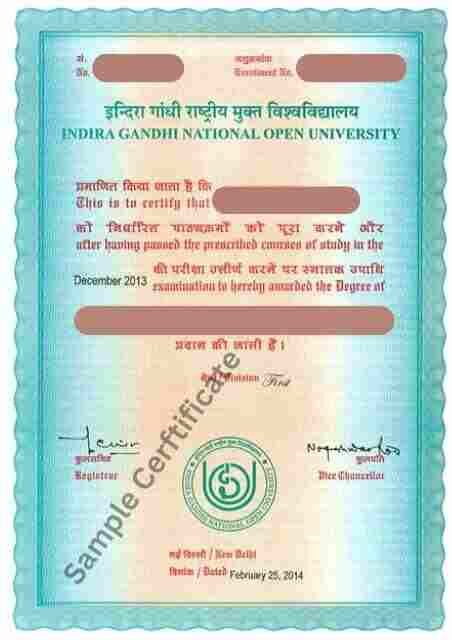
Sample Certificate of IGNOU PhD Programs
- Same online Doctorate/other degree as On Campus –Receive the same world-class education and global recognition as on-campus doctorates without the need to relocate
- Ranked Globally by CEOWorld –Ranked 69th globally by CEOWorld Magazine in the Best Business Schools Ranking
- Shorter Time to Completion –An innovative curriculum design, inspired by global standards that helps you earn your Doctorate faster.
IGNOU PhD Child Development Admission Process
Indira Gandhi National Open University (IGNOU) offers a flexible and largely online admission process for PhD Child Development doctoral programs. Candidates can apply through the official portal from anywhere in India. Admission confirmation timelines may vary depending on course type and document verification.
Here is the admission process for IGNOU:
- Step 1 – Verify Eligibility: Confirm your master’s degree falls under one of the six eligible qualification streams with 55%+ marks (50% for reserved categories). Check your UGC-NET status in Home Science / Psychology / Education and identify your admission category (I, II, III, or IV).
- Step 2 – Register on the Portal: Visit https://ignou-phd.samarth.edu.in/ and create a new account using a valid email ID and mobile number.
- Step 3 – Fill the Online Application Form: Enter personal details, educational qualifications, UGC-NET details (subject, score, certificate number, validity), proposed research area, and Full-Time / Part-Time preference. Only one discipline per application – submit a separate form if applying to PHDHC as well.
- Step 4 – Upload Documents: Passport photo, signature, master’s degree/provisional certificate, UGC-NET certificate, category certificate (SC/ST/OBC/EWS/PwD if applicable), employer NOC (Part-Time candidates), and valid government photo ID (Aadhaar / Passport / Voter ID / Driving Licence).
- Step 5 – Pay Application Fee: Rs. 2,000/- (non-refundable) via Net Banking, Credit Card, Debit Card, or UPI. Download and retain a copy of the submitted application form.
- Step 6 – Entrance Test (Category IV only): Candidates without a UGC-NET score must appear for IGNOU’s University-level Entrance Test in Child Development / Child & Family Studies / related areas. Must score minimum 50% (45% for reserved categories) to qualify for interview. Entrance test syllabus (Appendix II) is available on the IGNOU website.
- Step 7 – Interview / Viva-Voce: Mandatory for ALL categories. Conducted only at IGNOU Headquarters, Maidan Garhi, New Delhi. No TA/DA provided. Carry original photo ID. Evaluation criteria: Research Methodology (40%), Subject Domain Knowledge in Child Development (40%), Communication Skills (20%).
- Step 8 – Final Selection & Offer Letter: Merit list displayed on the official IGNOU website – no individual communication sent. Only selected candidates receive Offer Letters. Admission subject to Government of India reservation policy and availability of suitable research supervisors in the proposed research area.
Admission Categories & Weightage
| Category | Eligibility & Selection Weightage |
| Category I – UGC-NET with JRF (Home Science / Psychology / Education) | Directly called for Interview. Selection based 100% on Interview/Viva-Voce performance. Highest priority in seat allocation. JRF monthly stipend continues post-admission. |
| Category II – UGC-NET (Asst. Prof. + PhD eligible) | 70% weightage to UGC-NET score + 30% weightage to Interview/Viva-Voce performance. Second priority in seat allocation. |
| Category III – UGC-NET (PhD eligible only) | 70% weightage to UGC-NET score + 30% weightage to Interview/Viva-Voce performance. Third priority. |
| Category IV – University Entrance Test | Must score 50%+ in Entrance Test (45% for reserved categories). Merit: 70% Entrance Test + 30% Interview. Called in 1:5 ratio against available seats. |
Interview Evaluation Criteria
| Component | Weightage |
| Research Methodology | 40% |
| Subject Domain Knowledge (Child Development) | 40% |
| Communication Skills | 20% |
Few seats left with offers Apply now or pay more later!
Job Roles After IGNOU PhD Child Development Programs
Entry Level Leadership
- Assistant Professor – Child Development
- Research Associate – Child Development
- Child Development Researcher
- Research Fellow – Early Childhood Development
- Child Psychology Research Associate
- Developmental Research Associate
- Child Welfare Programme Associate
- Early Childhood Education Researcher
- Child Development Project Associate
- Family & Child Studies Research Associate
Mid Level Leadership
- Associate Professor – Child Development
- Senior Research Scientist – Child Development
- Senior Research Fellow – Early Childhood Development
- Child Development Programme Manager
- Senior Child Welfare Researcher
- Early Childhood Education Programme Manager
- Developmental Research Project Manager
- Child & Family Policy Consultant
- Monitoring & Evaluation Manager – Child Development
- Senior Research Consultant – Child & Family Studies
Senior Level Leadership
- Professor – Child Development & Family Studies
- Head – Child Development Research
- Dean – Human Development & Family Studies
- Director – Child Development Research Institute
- Director – Early Childhood Development Programmes
- Senior Child Policy Advisor
- Chief Programme Officer – Child Development
- Director – Child Welfare & Development Programmes
- Research Director – Child & Family Studies
- Executive Director – Child Development & Social Policy
IGNOU PhD Child Development Programs Curriculum (Syllabus/Subjects)
The Course Work for PHDCD consists of two substantive 8-credit papers, totalling 16 credits, plus the mandatory Research and Publication Ethics module (2 credits, as per UGC PhD Regulations 2022). All are taught at IGNOU campus with mandatory attendance.
IGNOU PhD Child Development Programs Curriculum
The pre-PhD coursework (first 6 months) is structured into 18 credits across 180 sessions and includes compulsory and elective components.
Compulsory Core Courses
| Course Code | Course Title, Credits & Description |
| RCD-001 (8 Credits) | Research Methodology – Comprehensive coverage of research paradigms applicable in social sciences and child development research, including quantitative, qualitative, and mixed-methods approaches. Topics: research design, hypothesis formulation, sampling techniques, qualitative and quantitative data collection tools, statistical software (SPSS), data analysis and interpretation. Special emphasis on ethical considerations in research with children – respecting children’s voices, informed assent/consent, cultural sensitivity, and reflective research practice. |
| RCD-002 (8 Credits) | Child Development – Explores child development across the lifespan with cultural, social, and policy dimensions. Covers Western and Indian theoretical frameworks, developmental theories, and perspectives on exclusion, gender inequality, and disability. Key topics include: role of family, peers, and media; neuroscientific insights into child development; family counselling and therapeutic techniques; equity and inclusion in child development (gender, socio-economic disparities, disability, minority identities); legal rights and social justice frameworks; contemporary debates on alternative family structures, resilience, and minority identities; policy and legislative provisions for diverse children and families. |
| Research & Publication Ethics (2 Credits) | Mandatory UGC-prescribed module covering academic integrity, plagiarism, citation norms, research misconduct, responsible authorship, publication ethics, and peer review processes. |
| Mini Research Practicum | A preliminary/pilot study designed and executed during course work under supervisor guidance – scholars develop a research design, conduct preliminary data collection, and present findings as part of course work assessment. |
Specialization Elective Courses (Research Domain Courses)
- Research Topic Finalization: Through structured consultations with the assigned PhD supervisor from SOCE faculty – aligned with existing expertise in the department
- Research Proposal Submission: Detailed proposal approved by the Doctoral Research Committee – includes title, objectives, literature review, theoretical framework, methodology, and timeline
- Ethics Clearance: Required for all research involving children as participants – IGNOU’s institutional ethics protocol and any applicable IRB requirements must be followed
- Comprehensive Literature Review: National and international academic work surveyed systematically – including Indian-language sources and grey literature on child welfare policy
- Theoretical / Conceptual Framework: Drawing from developmental theories (Piaget, Vygotsky, Bronfenbrenner’s Ecological Systems Theory, Attachment Theory, Resilience Theory) and Indian frameworks
- Data Collection Methods: Child observation protocols, standardized developmental assessments, parent and teacher interviews, focus group discussions, home visits, school-based surveys, case studies, secondary data analysis (NFHS, ASER, UDISE, DLHS datasets)
- Data Analysis: Statistical methods (SPSS, R), qualitative analysis (NVivo, thematic analysis, grounded theory, narrative inquiry), and mixed-methods approaches
- Thesis Writing: Chapter-by-chapter under supervisor guidance – Introduction, Literature Review, Theoretical Framework, Methodology, Results, Discussion, Conclusions and Implications
- Six-Monthly Progress Reports: Submitted to Doctoral Research Committee for review and continuation clearance – mandatory
- Annual Review Meeting: Formal progress presentation to the full Committee
- Pre-Submission Open Seminar: Presentation of completed findings before faculty, external reviewers, and peers – feedback incorporated before submission
- Plagiarism Check: Mandatory anti-plagiarism screening (Turnitin/iThenticate) as per UGC norms
- External Thesis Evaluation: Minimum 2 external examiners (including at least one from outside IGNOU) appointed by the University
- Open Viva-Voce (Final PhD Defense): Before supervisor, external examiner, and Head of SOCE – open to the academic community. Mandatory for PhD award.
Research Areas Available
- Early Childhood Development & Education (ECDE) – ages 0–6
- Cognitive Development, Language Acquisition & Literacy
- Social-Emotional Development & Attachment
- Developmental Disabilities – Autism Spectrum Disorder, intellectual disabilities, ADHD, cerebral palsy
- Special Education & Inclusive Education Research
- Child Maltreatment, Protection & Trauma
- Family Dynamics, Parenting Practices & Child Outcomes
- Gender & Child Development
- Child Poverty, Deprivation & Resilience
- Tribal & Indigenous Child Development
- Children in Conflict with Law / Juvenile Justice
- Play, Creativity & Child Well-being
- School Readiness & Transition to Formal Education
- Media, Technology & Child Development
- Child Rights, Policy & Legal Frameworks (POCSO, RTE, RPWD Act)
What is the Fees of an IGNOU PhD Child Development Programs?
- Starting at INR 16,800*/year
- Program Fees : INR ₹53,550/ * (Full 3-year Programme)
*Note: Fees once paid are non-refundable. International students are not eligible for this programme. Exam fee is not included in the above structure.
The total fee structure for the IGNOU Phd Child Development programs is INR 53,550/-, and this fee structure is uniform across all specializations/disciplines. The Ph.D. program consists of 6 semesters, with the total course price determined by the chosen specialization. IGNOU provides flexibility by allowing students to pay their tuition in installments or one big payment. International students can also enroll in the Ph.D program, however, their costs differ from those of Indian students. International students’ costs vary depending on specialization, dormitory fees, and other charges.
| IGNOU PhD Computer Science Fees Component | Amount (INR) |
| Registration & Coursework Fee (16 Credits – Year 1) | ₹17,850/- |
| Research and Publication Ethics – RPE-001 (Free Course) | ₹1,050/- (exam fee component) |
| University Development Fee | ₹200/- |
| Total First Year Fee | ₹18,050/- (All Inclusive) |
| Application Fee (Non-refundable) | ₹2,000/- |
| Total Fees for 3 Years | ₹53,550/- (Full 3-year Programme) |
Important Notes
– All fees are subject to change by the university and are non-refundable once paid.
– In case of extension beyond 3 years, annual fees continue to be charged as applicable.
– No separate fees are charged for library access, coursework materials, or lab usage (where applicable), unless otherwise notified by the school/discipline.
– For latest & updated information, you must visit IGNOU official website.
An Online DBA Is An Alternative to a Ph.D. Child Development from IGNOU
The word DBA stands for Doctor of Business Administration, it’s an alternative to a PhD in Management program that focuses on advanced business principles, leadership abilities, and research methods. A DBA program, like a Ph.D., requires extensive study and research in business-related fields, but with a practical, real-world focus. DBA candidates frequently research themes such as organizational behavior, strategic management, entrepreneurship, and global business concerns. A DBA program aims to produce highly trained business professionals who can give significant insights into the business world via rigorous academic study and practical application.
IGNOU offers a Ph.D. program but the course takes time and that will be hard for working professionals to complete their Ph.D. degree along with their work and to ease this problem. Interested candidates can go for the Online DBA program which is offered by various reputed foreign universities and holds the same value and recognition as a regular Ph.D. degree. Here is the list of some of the universities that provide online DBA programs:
Top 5 Online Doctoral Degree Universities Fees Comparison
| University | Online Doctorate Fees | Global Accreditations |
| Rushford Online DBA Doctorate | INR 6,50,000* | AACSB | ACBSP | EDUQUA |
| ESGCI Online DBA Doctorate, Paris | INR 6,50,000* | ACBSP | IACBE |
| GGU Online DBA Doctorate | INR 10,65,000* | AACSB | WES |
| Edgewood Online DBA Doctorate | INR 9,50,000* | WES | HLC |
| SSBM Online DBA Doctorate | INR 7,50,000* | ACBSP | BAC | EDUQUA |
EMI & Financial Support of IGNOU PhD Child Development Programs
IGNOU’s Ph.D. fee is among the most affordable doctoral programme fees in India, structured in annual installments. While IGNOU does not operate a formal EMI scheme, the following financial structures and support mechanisms are available to Child Development PhD scholars:
- All IGNOU PhD fees are paid online through the SAMARTH admission portal via Net Banking, Credit Card, Debit Card, or UPI
- IGNOU does not offer a direct in-house EMI plan – fees must be paid in full at admission (Year 1) and at annual re-registration (Year 2 onwards)
- The annual fee structure (Rs. 8,400/year from Year 2) is inherently affordable and spread across years, reducing the per-year financial burden significantly
- Education Loans with EMI: SBI Scholar Loan, PNB Saraswati, Canara Bank Vidyasaathi, and Bank of Baroda Baroda Vidya schemes offer education loans for IGNOU PhD scholars repayable in monthly installments – loan amounts typically Rs. 5–15 lakh
- UGC-JRF / ICSSR fellowship holders: Monthly stipends substantially exceed annual PhD fees – eliminating financial burden entirely
- UGC-JRF (Home Science / Psychology / Education NET-JRF): Rs. 37,000/month for first 2 years, Rs. 42,000/month from Year 3 onwards + HRA + annual contingency. The primary and most significant funding source for PHDCD scholars.
- UGC-SRF (Senior Research Fellowship): Upgrade from JRF at Year 3 on supervisor recommendation – Rs. 42,000/month + enhanced HRA and contingency
- ICSSR Doctoral Fellowship: The Indian Council of Social Science Research offers competitive doctoral fellowships for scholars in Child Development, Human Development, and allied social science areas – stipend + book grant + contingency. Apply at www.icssr.org
- DST-SERB National Post-Doctoral Fellowship (N-PDF): For recently awarded PhDs – Rs. 55,000/month + research grant. Relevant for PHDCD scholars pursuing postdoctoral research.
- National Fellowship for SC Students (NFSC): SC category PhD scholars receive monthly fellowship (JRF-equivalent) + Rs. 10,000/year contingency grant via UGC
- Rajiv Gandhi National Fellowship (RGNF): For ST category PhD scholars – monthly stipend + contingency + equipment grant
- Maulana Azad National Fellowship (MANF): For minority community PhD scholars – Rs. 31,000–35,000/month + contingency + equipment grant
- National Fellowship for Persons with Disabilities (UGC-PwD): For scholars with 40%+ benchmark disability – JRF-equivalent fellowship + contingency
- NIPCCD Research Grants: The National Institute of Public Cooperation and Child Development periodically offers research grants for studies aligned with national child welfare priorities – PHDCD scholars working on ICDS, ECCE, or child protection topics may be eligible
- State Government PhD Fellowships: Multiple state governments (Delhi, Maharashtra, Rajasthan, Tamil Nadu, Karnataka, Uttar Pradesh) offer dedicated PhD fellowships for scholars from state domicile – check your state Higher Education and Social Welfare departments
Emi Partners







Don’t Let Fees Delay Your Goals
Seats are filling fast, don’t lose yours over fees. Apply for EMI now and lock your admission today.
Scholarships of IGNOU PhD Child Development Programs
| Scholarship / Fellowship | Eligibility & Benefit |
| UGC-JRF (Home Science / Psychology / Education NET-JRF) | NET with JRF in relevant subject. Rs. 37,000/month (Yr 1–2) | Rs. 42,000/month (Yr 3+) + HRA + contingency. Best option for PHDCD scholars. |
| UGC-SRF | Upgrade from JRF after Year 2. Rs. 42,000/month + HRA + enhanced contingency grant. |
| ICSSR Doctoral Fellowship (Full-Time) | Social science research including Child Development, Human Development. Stipend + book grant + contingency. Competitive. Apply: www.icssr.org |
| ICSSR Doctoral Fellowship (Part-Time) | Employed scholars in social science research areas. Reduced stipend + contingency. Apply: www.icssr.org |
| National Fellowship for SC Students (NFSC) | SC category PhD scholars. JRF-equivalent monthly stipend + Rs. 10,000/year contingency grant via UGC. |
| Rajiv Gandhi National Fellowship (RGNF) | ST category PhD scholars. Monthly stipend + contingency + equipment grant via UGC. |
| Maulana Azad National Fellowship (MANF) | Minority community PhD scholars. Rs. 31,000 (JRF) to Rs. 35,000 (SRF)/month + contingency + equipment grant. |
| National Fellowship for PwD (UGC) | Benchmark disability (40%+). JRF-equivalent fellowship + contingency + equipment grant. |
| DST-SERB National Post-Doctoral Fellowship | For post-PhD researchers in social and education sciences. Rs. 55,000/month + Rs. 2 lakh/year research grant. |
| CRY (Child Rights and You) Research Grants | CRY periodically funds research on child rights, child labour, education access, and child protection in India – PHDCD scholars may apply for project-based funding. |
| NIPCCD Research Fellowships / Grants | National Institute of Public Cooperation and Child Development funds applied research aligned with ICDS, ECCE, child welfare policy – contact: nipccd.nic.in |
| State Government PhD Fellowships | Varies by state. Check state Higher Education Department / Social Welfare Department. Typically Rs. 3,000–12,000/month. |
IGNOU Latest News/Updates
UGCs Academic Collaboration between Indian and Foreign Higher Education Institutions to offer Twinning Programme, Joint Degree, Dual Degree and Regulations, 2022, Click here to know!
Prohibited Courses or Programmes in Online mode, Click here to know!
A degree obtained through ODL mode is equivalent to a traditional degree, Click here to know!
According to the latest UGC guidelines, all candidates must create their ABC ID and DEB ID to get admission.Click here to Know more!
What is Academic Bank of Credit (ABC) Notification by UGC? Must Watch!
Precautions to be taken by the students before enrolling for programs offered under ODL & Online Learning Mode, Click here to know!
UGC declares a 100% Fee Refund policy for students within a specified period by universities.Click here to read the full notice.
Latest @Open & Distance Learning. Click here to view all.
Latest @Online Learning. Click here to view all.
IGNOU PhD Child Development Programs Learning Advantages

Recognized Accreditation & Ranking
NIRF Rank 1 (Open University category) and NAAC A++ accreditation, with the programme run in compliance with UGC (Minimum Standards and Procedure for Award of Ph.D. Degree) Regulations, 2022.

Flexible Duration for All Candidates
Minimum 3 years, maximum 6 years to complete - with women candidates and PwD candidates (≥40% disability) granted an additional 2 years beyond the maximum duration.

Dual-Mode Admission Pathways
Multiple entry routes (NET-JRF, NET-only, or University Entrance Test) mean candidates with different qualification profiles not just NET/JRF holders have a genuine route into a PhD.

Full-Time and Part-Time Options
Working professionals can pursue the PhD part-time (with employer NOC), making it accessible without quitting a job - a core strength of IGNOU's distance/open-learning model.

Structured, Time-Bound Course Work
A defined 6-month Course Work at the start (mandatory 80% attendance) gives scholars a solid grounding in Research Methodology and subject domain before beginning independent research rather than being left to structure the process alone.

Inclusive & Reservation-Sensitive Admission
Strong built-in equity provisions 5% relaxation in marks for SC/ST/OBC-NCL/EWS/PwD candidates, 5% horizontal PwBD reservation across categories, and category-interchange rules ensuring reserved seats aren't wasted.
IGNOU PhD Child Development Programs LMS & Study Materials
- E-GyanKosh (www.egyankosh.ac.in): IGNOU’s open-access digital repository – free access to all PhD course materials, lecture notes, audio/video resources, and study guides for RCD-001 and RCD-002 course work papers. Available 24/7 without registration.
- e-ShodhSindhu (ess.inflibnet.ac.in): UGC’s national digital library for enrolled PhD scholars – access to 15,000+ peer-reviewed journals including Child Development, Developmental Psychology, Early Childhood Education Journal, Journal of Applied Developmental Psychology, and Indian databases. Invaluable for literature review.
- Shodhganga (shodhganga.inflibnet.ac.in): INFLIBNET’s repository of Indian PhD theses – access to previously completed IGNOU and other Indian university theses in Child Development, Home Science, and Psychology for systematic literature review
- Shodhgangotri: Research proposals of enrolled IGNOU scholars are registered here – prevents duplication and maps ongoing national research in child development
- SWAYAM (swayam.gov.in): Free online MOOCs in Research Methodology, Child Psychology, Special Education, Early Childhood Education, and allied subjects – valuable supplementary learning during course work
- NCERT E-Resources (ncert.nic.in): National Council for Educational Research and Training’s publications, curriculum frameworks (NCF-FS for early childhood), textbooks, and research reports – key secondary source for child development researchers in India
- NIPCCD Publications & Resources (nipccd.nic.in): National Institute of Public Cooperation and Child Development research papers, monographs, and policy briefs on ICDS, child welfare, ECCE, and family studies – free digital access
- ASER Reports (asercentre.org): Annual Status of Education Report data – India’s largest grassroots survey of child learning outcomes, used extensively in child development and education research
- IGNOU Central Library (Maidan Garhi Campus): Physical access for enrolled PhD scholars – extensive collection on Child Development, Developmental Psychology, Home Science, Education, Special Education, Disability Studies, and allied subjects + interlibrary loan facilities
- Course Work Classes: Face-to-face teaching at IGNOU campus during the mandatory 6-month course work – direct interaction with SOCE faculty including Prof. Rekha Sharma Sen and Prof. Deeksha Kapur, along with invited child development experts
- Supervisor Mentorship: Regular one-on-one research guidance from assigned SOCE faculty PhD supervisor – aligned with scholar’s specific research area (ECE, disability, child protection, family studies, etc.)
- Doctoral Research Committee Reviews: Structured six-monthly progress reviews provide formal accountability and early identification of research challenges
- IGNOU Academic Calendar & Research Seminars: SOCE conducts periodic workshops, colloquia, and seminars on child development research – scholars have access to peer feedback and expert presentations
- NFHS (National Family Health Survey) Data: IIPS Databank – key secondary dataset for child nutrition, development, vaccination, and family structure research in India
IGNOU PhD Child Development Programs Examination Pattern
- Two main papers – RCD-001 (Research Methodology, 8 credits) and RCD-002 (Child Development, 8 credits) – plus the Research and Publication Ethics module (2 credits) must be completed during the mandatory on-campus course work phase
- Assessment for each paper: continuous evaluation (assignments, seminar presentations, mini research practicum presentation) + term-end written examination
- 80% attendance in all course work sessions is strictly mandatory – non-compliance results in disqualification from the course work examinations
- All course work components must be passed before a scholar may proceed to the independent research phase
- Special emphasis in RCD-001: scholars must demonstrate competence in designing child-appropriate research (ethical considerations for research with minors – assent, consent, participant protection, reporting obligations)
- Six-Monthly Progress Reports: Detailed written report submitted to the Doctoral Research Committee every six months – covering literature reviewed, data collected/analysed, problems encountered, and next steps. Mandatory for continuation of registration.
- Annual Review Meeting: Formal presentation before the full Committee – scholars present progress visually and verbally, receive feedback, and must demonstrate satisfactory advancement
- Pre-Submission Open Seminar: Full presentation of research findings in an open department seminar – faculty, invited experts, and peer scholars attend. Feedback from this seminar must be incorporated into the final thesis.
- Plagiarism Screening: Mandatory anti-plagiarism check (Turnitin/iThenticate) before thesis submission – must meet UGC-specified similarity thresholds
- Thesis Submission: In IGNOU-prescribed format with all endorsements from supervisor, Head of SOCE, and ethics compliance certificates
- External Examination: Sent to minimum 2 external examiners (including one from outside IGNOU; may include an international examiner in child development or related field)
- Revision Process: Scholars may be required to revise and resubmit based on examiner feedback – standard practice for social science doctoral research
- Open Viva-Voce: Mandatory oral defense before supervisor, external examiner, and Head of SOCE – open to the academic community. PhD degree awarded upon successful completion.
- Course Work assessed on marks/grades as per IGNOU PhD Guidelines 2022
- The PhD degree itself is awarded upon successful completion of all requirements – not graded separately. Equivalent in status to any Central University PhD.
- IGNOU PhD is recognized by the Association of Indian Universities (AIU) for all equivalence purposes including teaching appointment, government service, and international academic applications
Job Roles & Average Annual Salary after IGNOU PhD in Child Development
| Role / Sector | Expected Annual Salary (India, 2025–26) |
| Assistant Professor (Government College/University) | Rs. 7–22 LPA (7th Pay Commission, Level 10–14) |
| Research Officer (NIPCCD / ICSSR / NCERT) | Rs. 5–15 LPA (Central Government scale) |
| Programme Director (Large NGO – UNICEF, CRY, Save the Children) | Rs. 8–25 LPA |
| WHO / UNICEF (National Officer – NO-B to NO-D) | Rs. 18–55 LPA |
| Child Development Consultant (Private) | Rs. 6–20 LPA (project-based) |
| School / ECCE Specialist Lead | Rs. 5–12 LPA |
| Child Psychologist / Counsellor (Senior) | Rs. 6–15 LPA |
IGNOU PhD Child Development Placement Partners & Career Scope
- Assistant Professor: UGC mandates PhD + NET for permanent appointment in Home Science, Child Development, Human Development, Education, or Psychology departments. IGNOU PHDCD fulfills this completely.
- Professorship: With research publications in UGC CARE-listed journals and post-PhD experience
- Research Supervisor: After obtaining a faculty position, PHDCD graduates can guide their own PhD scholars – multiplying research impact
| Role / Institution | Details |
| NIPCCD (National Institute of Public Cooperation and Child Development) | Research scientist, faculty, and programme evaluation roles at the national apex body for child development under MoWCD |
| Ministry of Women & Child Development | Technical Programme Manager, Research Advisor, ECCE curriculum development, ICDS reform research |
| NCPCR (National Commission for Protection of Child Rights) | Research Officer, Child Rights Policy Analyst |
| NCERT / SCERT | Curriculum designer for Foundational Stage (NEP 2020), teacher training specialist |
| State Child Welfare Departments | District Child Development Officer, CDPO, Child Protection Officer |
| NITI Aayog | Technical Expert on child development SDG indicators and POSHAN Abhiyaan evaluation |
| WHO / UNICEF India | Programme Officer / Technical Specialist – Early Childhood Development |













Live Placement Updates Are Rolling In!
Learners from recent batches are already getting shortlisted by hiring partners. Don’t miss your chance to be part of the next success story.
IGNOU Important Links
| Alumni Portal – 1 Link here | Know Your Status – 2 Link here |
| Convocation – 3 Link here | Reevaluation – 4 Link here |
| Convocation – 3 Link here | Reevaluation – 4 Link here |
| Convocation – 3 Link here | Reevaluation – 4 Link here |
| Convocation – 3 Link here | Reevaluation – 4 Link here |
IGNOU Address
Indira Gandhi National Open University (IGNOU)
Maidan Garhi, Chhatarpur, New Delhi, Delhi 110068
Explore Other Top Doctoral-Level Universities
DBA Worldwide Faculty & Fellows





Are you ready to take the next step in your career ?
Frequently Asked Questions About IGNOU PhD Child Development
Is IGNOU PhD in Child Development valid and recognized across India?
Yes. IGNOU is a Central University with NAAC A++ accreditation and NIRF #1 rank among Open Universities. The PHDCD degree is fully recognized by UGC, accepted by the Association of Indian Universities (AIU), and is valid for Assistant Professor appointment in Child Development, Human Development, Home Science, Education, or Psychology departments across India.
Which master's degrees are eligible for PHDCD admission?
Six qualification streams are accepted: (1) Master’s in Home Science / Community Science (General or with specialization in Child Development / Human Development / HDFS), (2) Master’s in Early Childhood Development, (3) M.A. in Education (ECCE), (4) M.A. in Education OR M.Ed. in Special Education (any disability area), (5) M.Sc. in Counselling and Family Therapy, and (6) Master’s in Psychology. All require minimum 55% marks (50% for reserved categories).
Which UGC-NET subjects are accepted for PHDCD eligibility?
UGC-NET in Home Science, UGC-NET in Psychology, and UGC-NET in Education – all three are accepted. This means candidates from diverse disciplinary backgrounds can qualify through whichever NET subject aligns with their master’s degree. Candidates without NET must appear for IGNOU’s University Entrance Test (Category IV).
How many seats are available for PHDCD in the July 2026 session?
15 seats total: UR=07, SC=02, ST=01, OBC=04, EWS=01 – the highest seat count among SOCE PhD programmes in this cycle. Seat availability varies each session; always verify with the current admission brochure’s Appendix I.
I have a composite/general Home Science M.Sc. Can I apply for both PHDCD and PHDHC?
Yes, but you must submit two separate applications – one for PHDCD and one for PHDHC. Applying for one does NOT automatically make you eligible for the other. Both applications attract the Rs. 2,000 non-refundable fee each.
Can a working professional (teacher / NGO worker / anganwadi supervisor) apply for PHDCD Part-Time?
Yes. IGNOU’s Part-Time PhD mode is designed for employed professionals. You must obtain a No Objection Certificate (NOC) from your employer. You will also need to arrange leave/flexible work schedule for the mandatory 6-month Course Work at IGNOU campus in New Delhi.
What are the two Course Work subjects in PHDCD and what do they cover?
RCD-001 (Research Methodology, 8 credits): Research design, quantitative, qualitative, and mixed-methods approaches, sampling, data analysis (SPSS), ethics in research with children. RCD-002 (Child Development, 8 credits): Development across the lifespan, Indian and Western theories, family dynamics, disability and inclusion, gender, socio-economic disparities, policy and legal frameworks, resilience. Plus a mandatory Research & Publication Ethics module (2 credits).
What financial support is available for PHDCD scholars?
UGC-JRF (NET-JRF in Home Science/Psychology/Education): Rs. 37,000–42,000/month is the primary support. ICSSR Doctoral Fellowship is highly relevant for child development researchers. SC scholars can apply for NFSC, ST scholars for RGNF, minority scholars for MANF, and PwD scholars for the UGC PwD fellowship. NIPCCD also offers occasional research grants for child welfare studies.
What is the total cost of IGNOU PhD in Child Development?
Approximately Rs. 2,000 (application) + Rs. 17,850 (Year 1) + Rs. 8,400/year (Year 2 onwards) + Rs. 5,000 (thesis fee). For a 3-year minimum PhD, the total is approximately Rs. 36,650 – making IGNOU PHDCD one of the most affordable doctoral programmes in the social sciences in India.
Does IGNOU provide accommodation for PhD scholars during course work?
No. IGNOU currently does not provide hostel facilities for PhD scholars. Candidates must arrange their own accommodation in New Delhi for the mandatory 6-month course work period. IGNOU campus is in Maidan Garhi, South Delhi – rental and PG accommodation is available in nearby areas including Saket, Hauz Khas, Malviya Nagar, and Greater Kailash.
Disclaimer
DoctoratePath.com is a free educational information platform designed to help learners explore and compare doctoral and advanced academic programs. Applicants apply directly to partner universities or institutions, and all admission-related and post-admission processes are handled solely by the respective educational institutions……
READ MORE
DoctoratePath does not collect tuition fees or deliver academic programs directly. Its role is limited to providing information and connecting prospective learners with institutions that may align with their academic and professional goals. DoctoratePath does not guarantee admissions, degree recognition, job placements, or employment outcomes. Any such claims, if made, are the sole responsibility of the awarding institution.
DoctoratePath does not award academic credits or degrees. All credits, degrees, and certifications are granted, accepted, and recognized solely at the discretion of the respective partner universities or awarding institutions. Learners are strongly encouraged to assess the suitability of any program based on their academic objectives, professional requirements, and career goals before enrolling. DoctoratePath does not guarantee the recognition, equivalence, or acceptance of any credential unless explicitly stated.
All content on DoctoratePath.com—including text, images, blogs, and other materials—is provided for informational purposes only and should not be considered an official offer, commitment, or representation by any university or institution.
Any statistics, outcomes, or performance indicators shared are indicative only and may vary based on individual circumstances. Past performance does not guarantee future results. Career guidance or support services, where offered, are subject to DoctoratePath’s applicable policies and the terms of partner institutions.
Programs offered through international partner universities are accredited in their respective countries. These programs are not recognized by the UGC (India) unless explicitly stated.
The faculty credentials, profiles, and related information displayed on this platform have been sourced from publicly available platforms such as LinkedIn and other open sources and are shared strictly for informational purposes only.
DoctoratePath does not claim, represent, or imply that these faculty members are employed by, affiliated with, or officially associated with DoctoratePath or any of its partner institutions unless explicitly stated.
Similarly, the logos, names, and references to doctoral universities or institutions are used solely for identification and informational purposes. Their inclusion does not imply any endorsement, partnership, affiliation, or authorization by the respective universities or institutions.
DoctoratePath.com makes no representations regarding the accuracy, completeness, or current status of such information and encourages users to verify details directly with the respective institutions.
The platform may include links to third-party websites or external resources for convenience. DoctoratePath has no control over the content, accuracy, or availability of these external sites, and their inclusion does not imply endorsement or recommendation.