

IGNOU PhD Translation Studies
325,000+ Degrees Conferred (2026) | 21 Schools of Study | 67 Regional Centres
Home >> IGNOU >> PhD Doctorate >> Translation Studies
IGNOU (Indira Gandhi National Open University) offers a Doctor of Philosophy (PhD) in Translation Studies under its School of Translation Studies and Training (SOTST), with the programme code PHDTT. The programme is designed to develop original researchers, academicians, translators, and language and cultural studies experts who contribute new knowledge to areas such as Translation Studies, Comparative Literature, Linguistics, Cultural Studies, interdisciplinary studies, and Indian Knowledge Systems.
- Accreditation: NAAC A++ | UGC | AICTE | AIU | NIRF
- Courses for Working Professionals
- Study Mode: Full-Time/Part Time
- Network Building & Alumni Connects
- EMI Options: You’ll have access to budget-friendly payment plans
- Last date of admission: OnGoing
This information is provided for audience reference only. The video has been sourced from YouTube as a free resource. We are not affiliated with the YouTube channel or its creators. The views and opinions expressed in the video are their own.
Learn From Top Ranked Doctorate Institutes & Universities



 Latest Updates
According to British Council, At the postgraduate level (which feeds into PhD admissions), Social Sciences holds the largest share of students at 18.6%, followed very closely by Management at 18.2%, then Science (15.1%), Indian Languages (7.9%), and Commerce (7.8%).
About IGNOU University PhD Translation Studies Programs
The Ph.D. in Translation Studies (PHDTT) at IGNOU is a research doctorate offered by the School of Translation Studies and Training (SOTST) – one of India’s most dedicated academic institutions for the study, practice, and research of translation. Introduced in January 2011, the PHDTT programme has already produced more than 30 doctoral graduates and continues to be a cornerstone of translation scholarship in India.
The programme aligns directly with the National Education Policy 2020, which emphasises Translation Studies as a national priority and proposes establishing an Indian Institute of Translation and Interpretation (IITI). IGNOU’s SOTST is among the institutions best positioned to contribute to this national vision.
India’s most established doctoral programme in Translation Studies: PHDTT was launched in 2011 and has already conferred doctorates to 30+ scholars – giving it a proven track record, a growing alumni network, and deep institutional expertise that newer programmes cannot match.
Ranking & Approvals of IGNOU PhD Translation Studies Programs
AACSB Member
IGNOU holds NAAC A++ grade - the highest accreditation grade available from the National Assessment and Accreditation Council.
UGC Recognition
IGNOU is recognised as a Central University by the University Grants Commission of India.
AIU Recognition
The Association of Indian Universities (AIU) recognises IGNOU degrees as equivalent to those conferred by its member universities - meaning the full equivalence applies across India's entire university membership.

NIRF Ranking
NIRF 2025 ranks IGNOU #1 in the Open Universities category - the top position in its class.
Build the Right Skills & Shape Your Future from Our Unbiased Career Counselling. Choose the right path and Get 100 % Unbiased Career Advice.
Claim Your 100% Free Guidance on 100+ Online Universities
Why Choose IGNOU PhD Translation Studies Programs
UGC-Recognized & Highly Credible Degree
A PhD from Indira Gandhi National Open University (IGNOU) is fully recognized by UGC and holds strong credibility across academia, government, and research institutions. Being a central university with NAAC A++ accreditation, it ensures your doctorate is valid for Assistant Professor roles, research positions, and promotions.
Affordable PhD with Pan-India Accessibility
IGNOU offers one of the most affordable PhD programs in India, making doctoral education accessible to a wider audience. With its nationwide network of regional centres, candidates from any location can pursue research without relocating, reducing overall cost burden.
Flexible Research Structure for Working Professionals
The program is designed with a flexible and research-driven approach, allowing working professionals to balance career and academics. With guided supervision, periodic reviews, and blended support, learners can progress at their own pace while maintaining professional commitments.
IGNOU PhD Translation Studies Key Facts & Advantages
- Directly aligned with NEP 2020 national priorities: The National Education Policy 2020 explicitly recognises Translation Studies as essential for knowledge dissemination across India’s multilingual society and proposes the Indian Institute of Translation and Interpretation (IITI). Scholars completing PHDTT are positioned at the forefront of this emerging national agenda.
- NAAC A++ accredited Central University with NIRF Rank 1 in the Open University category – the IGNOU doctorate carries the highest institutional credentials available for an open/distance doctorate in India, ensuring full recognition by UGC, universities, government bodies, and employers.
- UGC-compliant degree (UGC Ph.D. Regulations, 2022) – fully valid for Assistant Professor and higher academic appointments at Indian universities under NEP 2020 norms, with NET qualification.
- Unique interdisciplinary scope: PHDTT enables research not only in Translation Theory and Practice but also spans Comparative Literature, Linguistics, Cultural Studies, Indian Knowledge Systems, and Interdisciplinary Studies – making it one of the most intellectually versatile humanities doctorates available in India.
- India is a uniquely multilingual nation with 22 scheduled languages and hundreds of dialects – translation research here has enormous societal relevance, from knowledge democratisation to policy implementation, judicial access, medical communication, and literary preservation.
- Globally relevant in the AI era: Machine Translation, Neural Machine Translation (NMT), and AI-powered localisation tools are transforming the translation industry. SOTST integrates technology in translation in its academic programmes – Ph.D. scholars can contribute to cutting-edge research on Human-AI collaboration in translation.
- National Translation Mission (NTM) of India: The government’s NTM, under the Ministry of Education, is actively involved in translating knowledge texts across Indian languages. PHDTT scholars are directly employable in NTM research, evaluation, and coordination roles.
- Flexible Part-Time and Full-Time modes – ideal for professional translators, language teachers, editors, journalists, and academics who wish to pursue doctoral research without leaving their practice.
- Five structured coursework courses (18 Credits) – RTT-101 (Research Methodology), RTT-102 (Translation: Theory and Practice), RTT-103 (Critiquing Translation), RTT-104 (Translation and Power), and RPE (Research and Publication Ethics) – providing a comprehensive foundation for doctoral research in Translation Studies.
- Research on landmark texts: Course work includes case studies of canonical translations – Gitanjali (Tagore translated by himself), The Second Sex (de Beauvoir), Abhijnana Shakuntalam, and Raga Darbari – grounding scholars in the practical critique of major literary translations.
- Broad eligibility: Candidates with a Master’s degree in Translation Studies, Literature, Linguistics, Comparative Literature, Cultural Studies, or allied subjects are eligible – enabling entry from diverse language and humanities backgrounds.
- Global reach of SOTST: Through the MATS programme under MoEA’s E-Vidya Bharti project, SOTST already attracts international learners – making PHDTT part of a globally engaged Translation Studies school.
- Low total programme fee of Rs. 16,800 for the full programme – among the most affordable research doctorates in the country from a NAAC A++ accredited institution.
- Women candidates and Persons with Disabilities (40%+ disability) receive an additional 2-year extension beyond the maximum 6-year programme duration – reflecting IGNOU’s commitment to inclusive doctoral education.
Course Highlights of IGNOU PhD Translation Studies
| Parameter | Details |
| Programme Name | Ph.D. in Translation Studies (PHDTT) |
| Programme Code | PHDTT |
| Offered By | School of Translation Studies and Training (SOTST), IGNOU |
| Programme Type | Full-Time & Part-Time |
| Mode | Regular (Coursework at IGNOU HQ + Independent Research) |
| Programme Launch Year | January 2011 |
| Doctorates Awarded (Since 2011) | 30+ Ph.D. degrees conferred |
| Research Scope | Translation Theory & Practice, Comparative Literature, Linguistics, Cultural Studies, Indian Knowledge Systems, Machine Translation, Translation and Power |
| Medium of Instruction | English (research may be in other Indian languages as applicable) |
| Coursework Credits | 18 Credits (5 courses: RTT-101, RTT-102, RTT-103, RTT-104, RPE) |
| Minimum Duration | 3 Years (36 Months) |
| Maximum Duration | 6 Years |
| Extension (Women/PwD) | Additional 2 years beyond maximum duration |
| Total Programme Fee (Indian) | Rs. 16,800 (Full Programme) |
| Application Fee | Rs. 2,000 (Non-refundable) |
| Application Portal | https://ignou-phd.samarth.edu.in/ |
| Admission Session | July 2026 | Applications: 10 Jun – 01 Jul 2026 |
| Total Seats (July 2026) | 08 (UR-3, SC-1*, OBC-3, ST-0, EWS-1) |
| PwBD Reservation | 1 seat reserved for PwBD (Deaf/Hard of Hearing) within SC category |
| Accreditation | NAAC A++ | NIRF Rank 1 (OU Category) |
| UGC Compliance | UGC Ph.D. Regulations, 2022 | NEP 2020 Aligned |
| International Students | Not available for PHDTT |
| Contact | SOTST, IGNOU HQ, Maidan Garhi, New Delhi-110068 |
IGNOU PhD Translation Studies Programs Duration & Eligibility
Candidates must satisfy ONE of the following academic qualification requirements for IGNOU Ph.D. in Translation Studies course:
- Master’s degree with minimum 55% marks (50% for SC/ST/OBC-NCL/PwD/EWS) from a recognised university.
- OR: 4-year/8-semester Bachelor’s degree with 75%+ marks (70% for reserved categories) followed by a 1-year/2-semester Master’s degree programme.
- OR: M.Phil. degree with minimum 55% marks (50% for reserved categories).
- Equivalent qualification from a foreign educational institution accredited by a recognised assessment agency is also accepted.
Specific Eligibility for PHDTT
- Translation Studies – Primary/direct qualification
- Literature (any language – Hindi, English, Sanskrit, Regional Languages, etc.)
- Linguistics (Applied Linguistics, Comparative Linguistics, Sociolinguistics, etc.)
- Comparative Literature
- Cultural Studies
- Allied subjects as recognised by UGC/IGNOU (e.g., Languages, Media Studies with language focus, Indian Knowledge Systems)
Reserved Category Relaxation
- SC/ST/OBC (Non-Creamy Layer)/PwD/EWS: 5% relaxation in minimum marks (50% instead of 55%)
- 5% horizontal reservation for PwBD candidates with 40%+ benchmark disability – 1 seat in SC category is reserved for Deaf/Hard of Hearing category in July 2026.
- Women candidates and PwD scholars are eligible for up to 2 additional years beyond the maximum programme duration.
Program Duration
- Minimum Duration: 3 years (36 months)
- Maximum Duration: 6 years
- Additional Extension: Women candidates and PwD (40%+ disability or ‘severe’ where percentage is not defined) may avail up to 2 additional years beyond the maximum 6-year duration.
- Course Work Phase: Mandatory, conducted at IGNOU Headquarters, Maidan Garhi, New Delhi during the first year of admission. Minimum 80% physical attendance is compulsory.
IGNOU PhD Other Specialization
| IGNOU PhD Other Specialization / Research Area | Duration |
|---|---|
| PhD in Education | 3 – 6 Years |
| PhD in English | 3 – 6 Years |
| PhD in Hindi | 3 – 6 Years |
| PhD in Sociology | 3 – 6 Years |
| PhD in Political Science | 3 – 6 Years |
| PhD in Public Administration | 3 – 6 Years |
| PhD in Economics | 3 – 6 Years |
| PhD in Commerce | 3 – 6 Years |
| PhD in History | 3 – 6 Years |
| PhD in Geography | 3 – 6 Years |
| PhD in Library & Information Science | 3 – 6 Years |
| PhD in Journalism & Mass Communication | 3 – 6 Years |
| PhD in Tourism Studies | 3 – 6 Years |
| PhD in Translation Studies | 3 – 6 Years |
| PhD in Gender & Development Studies | 3 – 6 Years |
| PhD in Social Work | 3 – 6 Years |
| PhD in Rural Development | 3 – 6 Years |
| PhD in Development Studies | 3 – 6 Years |
| PhD in Population Studies | 3 – 6 Years |
| PhD in Computer Science | 3 – 6 Years |
| PhD in Information Technology | 3 – 6 Years |
| PhD in Environmental Science | 3 – 6 Years |
| PhD in Interdisciplinary & Transdisciplinary Studies | 3 – 6 Years |
| PhD in Distance Education | 3 – 6 Years |
| PhD in Adult Education | 3 – 6 Years |
| PhD in Special Education | 3 – 6 Years |
| PhD in Agriculture Extension | 3 – 6 Years |
| PhD in Food & Nutrition | 3 – 6 Years |
| PhD in Home Science | 3 – 6 Years |
Sample Certificate of IGNOU PhD Programs
- Same online Doctorate/other degree as On Campus –Receive the same world-class education and global recognition as on-campus doctorates without the need to relocate
- Ranked Globally by CEOWorld –Ranked 69th globally by CEOWorld Magazine in the Best Business Schools Ranking
- Shorter Time to Completion –An innovative curriculum design, inspired by global standards that helps you earn your Doctorate faster.
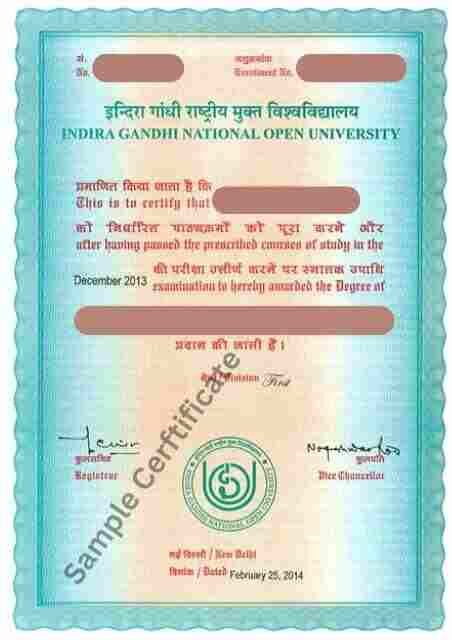
IGNOU PhD Translation Studies Admission Process
Indira Gandhi National Open University (IGNOU) offers a flexible and largely online admission process for PhD Translation Studies doctoral programs. Candidates can apply through the official portal from anywhere in India. Admission confirmation timelines may vary depending on course type and document verification.
Here is the admission process for IGNOU:
- Step 1 – Verify Eligibility: Confirm your master’s degree falls under one of the six eligible qualification streams with 55%+ marks (50% for reserved categories). Check your UGC-NET status in Home Science / Psychology / Education and identify your admission category (I, II, III, or IV).
- Step 2 – Register on the Portal: Visit https://ignou-phd.samarth.edu.in/ and create a new account using a valid email ID and mobile number.
- Step 3 – Fill the Online Application Form: Enter personal details, educational qualifications, UGC-NET details (subject, score, certificate number, validity), proposed research area, and Full-Time / Part-Time preference. Only one discipline per application – submit a separate form if applying to PHDHC as well.
- Step 4 – Upload Documents: Passport photo, signature, master’s degree/provisional certificate, UGC-NET certificate, category certificate (SC/ST/OBC/EWS/PwD if applicable), employer NOC (Part-Time candidates), and valid government photo ID (Aadhaar / Passport / Voter ID / Driving Licence).
- Step 5 – Pay Application Fee: Rs. 2,000/- (non-refundable) via Net Banking, Credit Card, Debit Card, or UPI. Download and retain a copy of the submitted application form.
- Step 6 – Entrance Test (Category IV only): Candidates without a UGC-NET score must appear for IGNOU’s University-level Entrance Test in translation studies related areas. Must score minimum 50% (45% for reserved categories) to qualify for interview. Entrance test syllabus (Appendix II) is available on the IGNOU website.
- Step 7 – Interview / Viva-Voce: Mandatory for ALL categories. Conducted only at IGNOU Headquarters, Maidan Garhi, New Delhi. No TA/DA provided. Carry original photo ID. Evaluation criteria: Research Methodology (40%), Subject Domain Knowledge in translation studies (40%), Communication Skills (20%).
- Step 8 – Final Selection & Offer Letter: Merit list displayed on the official IGNOU website – no individual communication sent. Only selected candidates receive Offer Letters. Admission subject to Government of India reservation policy and availability of suitable research supervisors in the proposed research area.
Admission Categories
- Category I – UGC-NET with JRF: Selection based entirely on Interview/Viva-Voce performance. Highest priority in merit list and seat allocation.
- Category II – UGC-NET (Assistant Professor + Ph.D.): Merit = 70% NET score + 30% Interview/Viva-Voce performance.
- Category III – UGC-NET (Ph.D. only): Merit = 70% NET score + 30% Interview/Viva-Voce performance.
- Category IV – University-level Entrance Test: For candidates without NET qualification. Minimum 50% in Entrance Test to qualify for Interview (45% for reserved categories). Final merit = 70% Entrance Test + 30% Interview/Viva-Voce. Candidates called in 1:5 ratio (seats:candidates) for interview.
Priority Order for Seat Allocation
- Category I (JRF) → Category II (NET AP+PhD) → Category III (NET PhD only) → Category IV (Entrance Test)
- Government of India reservation policy (SC/ST/OBC-NCL/EWS/PwBD) applies across all categories.
Interview / Viva-Voce Evaluation
- Research Methodology: 40%
- Subject Domain Knowledge (Translation Studies & allied subjects): 40%
- Communication Skills: 20%
Important Admission Notes
- Interview/Viva-Voce is mandatory for ALL categories. Conducted only at IGNOU Headquarters, Maidan Garhi, New Delhi. No TA/DA is provided to candidates.
- Valid original photo identity proof must be presented at the interview (Aadhaar Card, Voter ID, Driving Licence, Passport, or Government-issued ID).
- Part-Time candidates must submit a No Objection Certificate (NOC) from their employer in IGNOU’s prescribed format (Annexure IV) at the time of interview.
- Interview schedule and selected candidate lists are published on www.ignou.ac.in only – no individual communication is sent.
- Candidates applying under Category IV should select ‘NOT APPLICABLE’ against the UGC NET JRF option in the online form.
Few seats left with offers Apply now or pay more later!
Job Roles After IGNOU PhD Translation Studies Programs
Entry Level Leadership
- Assistant Professor of Commerce
- Research Associate – Commerce
- Research Fellow – Commerce & Business Studies
- Commerce Research Analyst
- Financial Research Associate
- Accounting Research Associate
- Taxation Research Associate
- Business Economics Research Associate
- Market Research Associate
- Academic Research Coordinator – Commerce
Mid Level Leadership
- Associate Professor of Commerce
- Senior Research Fellow – Commerce
- Senior Commerce Researcher
- Financial Research Manager
- Accounting Research Manager
- Tax Policy Research Consultant
- Business & Market Research Manager
- Commerce Programme Manager
- Senior Financial Analyst
- Research Project Manager – Commerce & Business Studies
Senior Level Leadership
- Professor of Commerce
- Head of Commerce Department
- Dean – Commerce & Business Studies
- Director – Commerce Research Institute
- Director – Business & Economic Research
- Senior Finance & Policy Advisor
- Chief Research Officer – Business & Commerce
- Research Director – Accounting & Finance
- Academic Director – Commerce & Management
- Executive Director – Business Research & Policy
IGNOU PhD Translation Studies Programs Curriculum (Syllabus/Subjects)
The PHDTT programme is structured in two phases: a mandatory Coursework phase (conducted at IGNOU HQ, New Delhi, during the first year of admission) and the Research Phase (independent doctoral research under supervisor guidance). The Coursework comprises 5 courses totalling 18 credits.
IGNOU PhD Translation Studies Programs Curriculum
The pre-PhD coursework (first 6 months) is structured into 18 credits across 180 sessions and includes compulsory and elective components.
Compulsory Core Courses
| Course Code & Title | Credit & Detailed Content |
| RTT-101: Research Methodology (Theory) | 4 CreditsSystematic approach to research in Translation Studies. Covers: qualitative methods (interviews, case studies, ethnographic research), quantitative methods (surveys, statistical analysis, experiments), hybrid (mixed-methods) approaches, identification of research problems, hypothesis formation, literature review strategies, data collection and analysis, knowledge generation, and academic style sheets. Ensures validity, reliability, and generalizability of doctoral research. |
| RTT-102: Translation: Theory and Practice (Theory) | 4 CreditsHistory and evolution of translation from word-for-word and sense-for-sense approaches to modern Translation Studies as a discipline. Covers: major Indian and Western translation theories, developments in contemporary translation practices, translation in technologically driven 21st-century contexts, implications of translation approaches across fields. Hones researcher’s theoretical and applied knowledge of translation. |
| RTT-103: Critiquing Translation (Theory) | 4 CreditsAssessment and evaluation of translated texts on textual, contextual, lexicographical, and socio-cultural parameters. Case studies include: Gitanjali (Rabindranath Tagore’s self-translation, English), The Second Sex (Simone de Beauvoir, French-to-English), Abhijnana Shakuntalam (Kalidasa, Sanskrit-to-English), and Raga Darbari (Shrilal Shukla, Hindi literary translation). Equips scholars to evaluate translation quality with depth and specificity. |
| RTT-104: Translation and Power (Theory) | 4 CreditsTranslation as more than a linguistic exercise – situated within ideology, patronage, and politics. Covers: ideology and translation, cultural and political hegemony, role of state and language in text selection and translation, patron-translator-reader power dynamics, postcolonial translation theory, censorship and translation, translation as an act of cultural resistance. Scholars understand the deep ideological dimensions of translation practice. |
| RPE: Research and Publication Ethics (Theory) | 2 CreditsResearch ethics in the context of Translation Studies. Covers: intellectual property rights, plagiarism prevention, proper citation practices, research publication ethics, norms for academic writing, peer review process, authorship and originality standards. Prepares scholars for ethical doctoral research and responsible academic publishing. |
Specialization Elective Courses (Research Domain Courses)
- Synopsis Submission: After completing Course Work, the scholar submits a research synopsis to the Doctoral Research Committee (DRC) outlining the research problem, objectives, methodology, theoretical framework, and expected scholarly contribution to Translation Studies.
- Research Work: Conducted independently under the supervision of an IGNOU SOTST faculty member or approved supervisor in the relevant research area.
- Annual/Half-yearly Progress Seminars: Open presentations before the DRC – assessed on research advancement, quality of writing, and timelines.
- Pre-Submission Seminar: Mandatory open seminar at IGNOU campus before thesis submission – evaluated by SOTST faculty and invited external experts.
- Thesis Submission: Final thesis evaluated by minimum two external examiners (including one from outside India as per UGC Ph.D. Regulations 2022) for original contribution to Translation Studies knowledge.
- Open Viva Voce: Final oral examination before a panel of examiners – degree awarded upon successful completion.
Research Areas Available
- Translation theory: classical Indian translation tradition, Western translation theories (Nida, Newmark, Venuti, Toury, etc.)
- Literary translation: Hindi, English, Sanskrit, and Indian regional language literary works
- Translation and postcolonialism: imperial languages, decolonisation of knowledge through translation
- Comparative Literature and Translation: cross-cultural literary analysis through translated texts
- Machine Translation and AI: NMT evaluation, post-editing quality, human-AI collaboration in translation
- Translation and Indian Knowledge Systems: translating classical texts, Vedic literature, traditional sciences
- Legal and judicial translation: access to justice in regional languages, court interpretation
- Medical, scientific, and technical translation: regulatory documents, clinical trials, pharmaceutical texts
- Translation pedagogy: teaching translation in multilingual Indian classrooms under NEP 2020
- Translation and ideology / censorship: political dimensions of text selection and rendering
- Subtitling, dubbing, and screen translation: OTT localisation quality and methodology
- Translation among Indian languages: Hindi-regional language, inter-regional, and tribal language translation
What is the Fees of an IGNOU PhD Translation Studies Programs?
- Starting at INR 16,800*/year
- Program Fees : INR ₹53,550/ * (Full 3-year Programme)
*Note: Fees once paid are non-refundable. International students are not eligible for this programme. Exam fee is not included in the above structure.
The total fee structure for the IGNOU Phd Translation Studies programs is INR 53,550/-, and this fee structure is uniform across all specializations/disciplines. The Ph.D. program consists of 6 semesters, with the total course price determined by the chosen specialization. IGNOU provides flexibility by allowing students to pay their tuition in installments or one big payment. International students can also enroll in the Ph.D program, however, their costs differ from those of Indian students. International students’ costs vary depending on specialization, dormitory fees, and other charges.
| IGNOU PhD Computer Science Fees Component | Amount (INR) |
| Registration & Coursework Fee (16 Credits – Year 1) | ₹17,850/- |
| Research and Publication Ethics – RPE-001 (Free Course) | ₹1,050/- (exam fee component) |
| University Development Fee | ₹200/- |
| Total First Year Fee | ₹18,050/- (All Inclusive) |
| Application Fee (Non-refundable) | ₹2,000/- |
| Total Fees for 3 Years | ₹53,550/- (Full 3-year Programme) |
Important Notes
– All fees are subject to change by the university and are non-refundable once paid.
– In case of extension beyond 3 years, annual fees continue to be charged as applicable.
– No separate fees are charged for library access, coursework materials, or lab usage (where applicable), unless otherwise notified by the school/discipline.
– For latest & updated information, you must visit IGNOU official website.
An Online DBA Is An Alternative to a Ph.D. Translation Studies from IGNOU
The word DBA stands for Doctor of Business Administration, it’s an alternative to a PhD in Management program that focuses on advanced business principles, leadership abilities, and research methods. A DBA program, like a Ph.D., requires extensive study and research in business-related fields, but with a practical, real-world focus. DBA candidates frequently research themes such as organizational behavior, strategic management, entrepreneurship, and global business concerns. A DBA program aims to produce highly trained business professionals who can give significant insights into the business world via rigorous academic study and practical application.
IGNOU offers a Ph.D. program but the course takes time and that will be hard for working professionals to complete their Ph.D. degree along with their work and to ease this problem. Interested candidates can go for the Online DBA program which is offered by various reputed foreign universities and holds the same value and recognition as a regular Ph.D. degree. Here is the list of some of the universities that provide online DBA programs:
Top 5 Online Doctoral Degree Universities Fees Comparison
| University | Online Doctorate Fees | Global Accreditations |
| Rushford Online DBA Doctorate | INR 6,50,000* | AACSB | ACBSP | EDUQUA |
| ESGCI Online DBA Doctorate, Paris | INR 6,50,000* | ACBSP | IACBE |
| GGU Online DBA Doctorate | INR 10,65,000* | AACSB | WES |
| Edgewood Online DBA Doctorate | INR 9,50,000* | WES | HLC |
| SSBM Online DBA Doctorate | INR 7,50,000* | ACBSP | BAC | EDUQUA |
EMI & Financial Support of IGNOU PhD Translation Studies Programs
IGNOU’s Ph.D. fee is among the most affordable doctoral programme fees in India, structured in annual installments. While IGNOU does not operate a formal EMI scheme, the following financial structures and support mechanisms are available to Translation Studies PhD scholars:
- IGNOU does not offer an official EMI or instalment scheme for Ph.D. programme fees. The programme fee is collected as a lump sum online at the time of admission through the Samarth portal.
- Given the affordable total fee of Rs. 16,800, one-time payment is considerably more accessible compared to Ph.D. programmes at private universities.
- Candidates paying via credit card through the Samarth portal may explore bank-level EMI conversion options available on their credit cards – this is at the bank’s discretion and not an IGNOU provision.
- UGC-JRF Fellowship (Primary Support): Category I candidates (UGC-NET with JRF) receive Rs. 37,000/month (JRF phase, first 2 years), upgraded to Rs. 42,000/month (SRF phase, remaining tenure), plus annual contingency grants for books, fieldwork, and conference travel.
- ICSSR Junior Research Fellowship: Relevant for scholars whose translation research intersects social sciences – ICSSR-JRF provides Rs. 31,000/month for 2 years with SRF upgrade. Apply via icssr.org. Translation and society, translation and politics, translation and identity are ICSSR-eligible themes.
- National Fellowship for SC Students (NFSC): Full programme fee reimbursement + monthly stipend (Rs. 25,000–31,000/month) for up to 5 years for SC scholars. Apply via National Scholarship Portal (scholarships.gov.in).
- National Fellowship for OBC Students (NFOBC): Partial fee support + stipend for OBC-NCL scholars. Apply via scholarships.gov.in.
- Maulana Azad National Fellowship (MANF): Full financial assistance for 5 years for minority community scholars (Muslim, Christian, Buddhist, Sikh, Parsi, Jain). Apply via scholarships.gov.in.
- Rajiv Gandhi National Fellowship (RGNF) for ST Candidates: Full financial support for Ph.D. for Scheduled Tribe scholars – fee reimbursement + monthly stipend for up to 5 years. Apply via UGC/NSP portal.
- National Translation Mission (NTM) Research Grants: Scholars working on Indian language translation projects may be eligible for NTM project grants through their supervisor. Contact SOTST for information on ongoing NTM projects.
- Sahitya Akademi Research Grants: The national academy of letters provides grants for literary translation research – particularly relevant for scholars working on Indian literary text translation.
- State Government Fellowships: Multiple states offer Ph.D. fellowships for domicile scholars. Check State Social Welfare / Higher Education Department portals for current schemes.
Emi Partners







Don’t Let Fees Delay Your Goals
Seats are filling fast, don’t lose yours over fees. Apply for EMI now and lock your admission today.
Scholarships of IGNOU PhD Translation Studies Programs
| Scholarship / Fellowship | Eligibility & Key Details |
| UGC-JRF Fellowship | Category I (NET-JRF holders): Rs. 37,000/month (2 yrs) → Rs. 42,000/month (SRF). Plus annual contingency grant. Highest-value fellowship. Apply via ugcnetonline.in. |
| ICSSR Junior Research Fellowship (JRF) | Social science / humanities scholars: Rs. 31,000/month for 2 years + SRF. Particularly applicable for translation research with social/cultural/political dimensions. Apply at icssr.org. |
| National Fellowship for SC Students (NFSC) | SC scholars: Full fee reimbursement + Rs. 25,000-31,000/month for up to 5 years. Apply via NSP (scholarships.gov.in). |
| National Fellowship for OBC Students (NFOBC) | OBC-NCL scholars: Partial fee support + monthly stipend. Apply via NSP (scholarships.gov.in). |
| Rajiv Gandhi National Fellowship (RGNF) for ST | ST scholars: Full financial support for up to 5 years. Apply via UGC / NSP portal. |
| Maulana Azad National Fellowship (MANF) | Minority scholars (Muslim, Christian, Buddhist, Sikh, Parsi, Jain): Full financial support for 5 years. Apply via NSP (scholarships.gov.in). |
| National Translation Mission (NTM) Project Grants | Scholars involved in Indian language translation research may access NTM-funded projects through SOTST supervisor. Contact SOTST for ongoing project opportunities. |
| Sahitya Akademi Translation Grants | Scholars working on Indian literary translation projects may apply for Sahitya Akademi grants for translation of significant literary works. Visit sahitya-akademi.gov.in. |
| Indira Gandhi Scholarship for Single Girl Child | UGC scheme for unmarried single girl child: Rs. 36,200/year. Check Ph.D. level applicability at UGC website. |
| State Government Fellowships | Varies by state – check State Social Welfare / Higher Education Department portal for domicile-based Ph.D. fellowship schemes. |
IGNOU Latest News/Updates
UGCs Academic Collaboration between Indian and Foreign Higher Education Institutions to offer Twinning Programme, Joint Degree, Dual Degree and Regulations, 2022, Click here to know!
Prohibited Courses or Programmes in Online mode, Click here to know!
A degree obtained through ODL mode is equivalent to a traditional degree, Click here to know!
According to the latest UGC guidelines, all candidates must create their ABC ID and DEB ID to get admission.Click here to Know more!
What is Academic Bank of Credit (ABC) Notification by UGC? Must Watch!
Precautions to be taken by the students before enrolling for programs offered under ODL & Online Learning Mode, Click here to know!
UGC declares a 100% Fee Refund policy for students within a specified period by universities.Click here to read the full notice.
Latest @Open & Distance Learning. Click here to view all.
Latest @Online Learning. Click here to view all.
IGNOU PhD Translation Studies Programs Learning Advantages

Recognized Accreditation & Ranking
NIRF Rank 1 (Open University category) and NAAC A++ accreditation, with the programme run in compliance with UGC (Minimum Standards and Procedure for Award of Ph.D. Degree) Regulations, 2022.

Flexible Duration for All Candidates
Minimum 3 years, maximum 6 years to complete - with women candidates and PwD candidates (≥40% disability) granted an additional 2 years beyond the maximum duration.

Dual-Mode Admission Pathways
Multiple entry routes (NET-JRF, NET-only, or University Entrance Test) mean candidates with different qualification profiles not just NET/JRF holders have a genuine route into a PhD.

Full-Time and Part-Time Options
Working professionals can pursue the PhD part-time (with employer NOC), making it accessible without quitting a job - a core strength of IGNOU's distance/open-learning model.

Structured, Time-Bound Course Work
A defined 6-month Course Work at the start (mandatory 80% attendance) gives scholars a solid grounding in Research Methodology and subject domain before beginning independent research rather than being left to structure the process alone.

Inclusive & Reservation-Sensitive Admission
Strong built-in equity provisions 5% relaxation in marks for SC/ST/OBC-NCL/EWS/PwD candidates, 5% horizontal PwBD reservation across categories, and category-interchange rules ensuring reserved seats aren't wasted.
IGNOU PhD Translation Studies Programs LMS & Study Materials
- eGyanKosh (http://www.egyankosh.ac.in/): IGNOU’s national digital repository – provides access to Self-Learning Materials (SLMs) for all IGNOU programmes. MATS (MA Translation Studies) SLMs are publicly available and serve as excellent supplementary reading for PHDTT scholars during Course Work.
- INFLIBNET N-LIST / e-ShodhSindhu: IGNOU scholars access thousands of international peer-reviewed e-journals and e-books via INFLIBNET – including key translation studies journals: Target, The Translator, Babel, Meta: Journal des Traducteurs, Translation Studies (Routledge), JoSTrans (Journal of Specialised Translation), and complete access to JSTOR’s humanities and linguistics collections.
- Shodhganga (http://shodhganga.inflibnet.ac.in/): India’s repository of 600,000+ Ph.D. theses – essential for literature review in Translation Studies, mapping existing Indian doctoral research on translation, and identifying research gaps.
- Shodhgangotri: Synopses repository – helps scholars understand concurrent doctoral research and avoid duplication in ongoing PHDTT research.
- SWAYAM Platform / e-PG Pathshala: Free online courses and PG-level content in Linguistics, Literature, and related subjects – useful supplementary resources for coursework preparation.
- National Translation Mission Digital Repository: NTM maintains a digital library of translated knowledge texts across Indian languages – directly relevant for scholars working on Indian language translation research.
- Sahitya Akademi Digital Resources: Sahitya Akademi’s online library includes translated Indian literary works, translation awards database, and research publications in Translation Studies.
- Coursework Study Material: IGNOU’s SOTST distributes printed Self-Learning Materials (SLMs) for all 5 Course Work courses (RTT-101, RTT-102, RTT-103, RTT-104, RPE) during the residential coursework sessions at IGNOU HQ. These are developed by SOTST faculty with expert contributions.
- IGNOU Central Library (Maidan Garhi): Provides access to printed books, reference volumes, and specialised collections in Translation Studies, Comparative Literature, Linguistics, and Cultural Studies – including rare volumes and Indian language literary works.
- SOTST School Library / Resource Centre: SOTST maintains its own academic resources for translation research, including books, journals, and working documents related to translation theory and Indian translation practice.
- Supervisor-Guided Reading: Each scholar’s supervisor provides a curated reading list – covering translation theory texts, language-specific resources, and access to relevant Indian language primary source materials essential for the research.
- New Delhi Academic Ecosystem: IGNOU’s New Delhi location gives scholars access to the National Archives of India (historical translation documents), National Library (rare Indian language collections), JNU Library (strong Translation Studies section), and Sahitya Akademi Library.
IGNOU PhD Translation Studies Programs Examination Pattern
- Attendance: Minimum 80% physical attendance in Course Work sessions at IGNOU HQ is strictly mandatory. Non-compliance results in ineligibility to proceed to the research phase.
- Course Work Examination: End-term examinations and/or continuous assessment for all 5 courses (RTT-101, RTT-102, RTT-103, RTT-104, RPE) as per IGNOU Ph.D. Guidelines 2022.
- Passing Criteria: Scholars must pass all 5 Course Work courses with the minimum qualifying score before proceeding to synopsis submission and doctoral research.
- Synopsis Presentation (DRC Stage): Scholar presents research proposal to the Doctoral Research Committee – evaluated on originality, theoretical framework (translation theory), methodology, and scholarly contribution to Translation Studies.
- Annual/Half-Yearly Progress Seminars: Open presentations before the DRC – assessed on research advancement, writing quality, and timeline adherence.
- Pre-Submission Seminar: Mandatory open seminar at IGNOU campus before thesis submission – evaluated by SOTST faculty and external Translation Studies scholars invited as expert members.
- Thesis Evaluation: Submitted thesis assessed by minimum two external examiners (one from outside India as mandated by UGC Ph.D. Regulations 2022) for original contribution to Translation Studies knowledge.
- Open Viva Voce: Final oral examination publicly conducted – scholar defends research findings, translation theory framework, and scholarly claims. Degree awarded upon successful completion.
- Syllabus: Available as Appendix II on IGNOU official website – covers Research Methodology and Translation Studies subject knowledge including translation theory, history, and practice.
- Qualifying Score: Minimum 50% marks in Entrance Test (45% for reserved categories) to be eligible for Interview/Viva-Voce.
- Merit Weightage: 70% Entrance Test + 30% Interview/Viva-Voce.
- Interview Ratio: Candidates called in 1:5 ratio (available seats:candidates) for the Interview stage.
Job Roles & Average Annual Salary after IGNOU PhD in Translation Studies
| Role | Indicative Monthly Salary (INR) |
| Assistant Professor (Government University) | Rs. 57,700 – 1,82,400 (7th Pay Commission, Level 10) |
| Translation Officer (Central Government) | Rs. 44,900 – 1,42,400 (Level 7, 7th Pay Commission) |
| Official Language Officer (PSU/Bank) | Rs. 40,000 – 1,00,000+ |
| NTM Research Associate / Coordinator | Rs. 40,000 – 80,000 |
| Localisation Project Manager (Tech Company) | Rs. 80,000 – 2,00,000+ |
| UN Language Professional (P-2 to P-4 level) | USD 3,000 – 7,000/month equivalent |
| Senior Literary Translator / Editor (Publishing) | Rs. 50,000 – 1,50,000 + royalties |
| Independent Translation Consultant | Rs. 60,000 – 3,00,000+ (project-based) |
IGNOU PhD Translation Studies Placement Partners & Career Scope
1) India’s Translation Economy – A Growing Sector
- India has 22 scheduled languages under the 8th Schedule, hundreds of regional dialects, and a massive government push under NEP 2020 for education in mother tongues – creating an unprecedented demand for professional and research-grade translators.
- India’s language services market is estimated to be among the fastest-growing in Asia – driven by OTT platform expansion, e-government initiatives in regional languages, MSME export documentation, and pharmaceutical/medical localisation requirements.
- National Translation Mission (NTM): Government’s flagship programme for translating knowledge texts across Indian languages is a direct employment pipeline for Ph.D.-qualified translation researchers.
- NEP 2020’s IITI (Indian Institute of Translation and Interpretation): When established, it will require senior faculty, researchers, and academic leaders – PHDTT graduates will be the primary pool for these positions.
2) Academic Career Path
- Assistant Professor to Professor positions in Translation Studies, Comparative Literature, Linguistics, and Language Departments at Indian universities – directly eligible post Ph.D. + NET.
- Post-Doctoral Fellowships: ICSSR Post-Doctoral (Rs. 50,000/month), UGC Post-Doctoral, Commonwealth Academic Fellowships, and international fellowships in Translation Studies.
- Academic leadership at Translation Studies departments being established in universities under NEP 2020 – a major demand driver in the coming decade.
2) Placement Support at IGNOU
- IGNOU provides Placement Assistance support through the Student Services portal at www.ignou.ac.in.
- SOTST faculty maintain active networks with NTM, Sahitya Akademi, CIIL, publishing houses, and language policy bodies – providing referral and recommendation support to doctoral scholars.
- PHDTT scholars are encouraged to present research at national and international Translation Studies conferences – including Translation India, Annual International Conference of Translation Studies, and global forums such as EST (European Society for Translation Studies) congresses.









Live Placement Updates Are Rolling In!
Learners from recent batches are already getting shortlisted by hiring partners. Don’t miss your chance to be part of the next success story.
IGNOU Important Links
| Alumni Portal – 1 Link here | Know Your Status – 2 Link here |
| Convocation – 3 Link here | Reevaluation – 4 Link here |
| Convocation – 3 Link here | Reevaluation – 4 Link here |
| Convocation – 3 Link here | Reevaluation – 4 Link here |
| Convocation – 3 Link here | Reevaluation – 4 Link here |
IGNOU Address
Indira Gandhi National Open University (IGNOU)
Maidan Garhi, Chhatarpur, New Delhi, Delhi 110068
Explore Other Top Doctoral-Level Universities
DBA Worldwide Faculty & Fellows





Are you ready to take the next step in your career ?
Frequently Asked Questions About IGNOU PhD Translation Studies
Is IGNOU Ph.D. in Translation Studies recognised for teaching positions in Indian universities?
Yes. IGNOU is a UGC-recognised Central University with NAAC A++ accreditation. The Ph.D. degree from IGNOU is fully valid for applying to Assistant Professor positions in Translation Studies, Comparative Literature, Linguistics, and Language Departments as per UGC NEP 2020 norms. You must also hold a valid UGC-NET score for academic appointments.
How many doctorates have been awarded by IGNOU's PHDTT programme?
More than 30 Ph.D. degrees have been conferred since the programme’s launch in January 2011. This makes PHDTT one of India’s most established doctoral programmes in Translation Studies with a proven track record, ongoing research community, and an alumni network in academia, government, and the translation industry.
I have a Master's degree in Hindi / English Literature - am I eligible for PHDTT?
Yes. The specific eligibility for PHDTT includes Master’s degrees in Literature (of any language), Linguistics, Comparative Literature, Cultural Studies, and Translation Studies. A Master’s in Hindi or English Literature qualifies you to apply for PHDTT. Your research proposal should demonstrate a clear connection to Translation Studies as a discipline.
Can a working translator or language professional pursue PHDTT part-time?
Yes. IGNOU specifically offers Part-Time mode for employed candidates. Working translators, language officers, editors, teachers, and journalists can pursue PHDTT without leaving their careers. The only mandatory residential period is the Course Work phase (first year) at IGNOU HQ, New Delhi (80% attendance). After completing course work, research proceeds independently. Employed candidates must submit an NOC from their employer at the time of interview.
What are the 5 coursework courses in PHDTT?
PHDTT has five coursework courses: RTT-101 (Research Methodology, 4 credits), RTT-102 (Translation: Theory and Practice, 4 credits), RTT-103 (Critiquing Translation, 4 credits – includes case studies of Gitanjali, The Second Sex, Abhijnana Shakuntalam, and Raga Darbari), RTT-104 (Translation and Power, 4 credits – ideology, politics, and patronage in translation), and RPE (Research and Publication Ethics, 2 credits). Total: 18 credits.
What is the total fee for IGNOU Ph.D. in Translation Studies?
The total programme fee for Indian nationals is Rs. 16,800 for the full programme. There is also a non-refundable application fee of Rs. 2,000. Examination fees and thesis submission fees are charged separately as per University norms. This programme is not available for international students.
Is there any scholarship or financial support available for PHDTT scholars?
Yes. UGC-JRF holders (Category I) receive Rs. 37,000–42,000/month. ICSSR-JRF is available for humanities and social science translaton research. SC/ST/OBC/Minority scholars can access NFSC, RGNF, MANF, and NFOBC via the National Scholarship Portal. Additionally, NTM research project grants and Sahitya Akademi grants are specifically relevant for PHDTT scholars working on Indian language translation.
How many seats are available in PHDTT for July 2026?
There are 8 total seats: UR-3, SC-1 (including 1 reserved for PwBD Deaf/Hard of Hearing), OBC(NCL)-3, EWS-1. No ST seats are available in this session. Given the competitive intake, a well-articulated research proposal and strong preparation for the Interview/Viva-Voce are critical.
Can I pursue PHDTT research in Hindi or a regional language (not English)?
Yes. The medium of instruction is English, but research in PHDTT can legitimately involve Hindi and other Indian languages as the primary language of investigation, source texts, or target texts. Translation research often requires working across multiple languages. Scholars can work on Hindi-English, Hindi-Regional Language, inter-regional, or classical-to-modern translation topics. Confirm the specific language arrangements with your supervisor.
When do applications open and how do I apply for PHDTT July 2026?
Applications for July 2026 opened on 10 June 2026 and close on 01 July 2026. Apply online only at https://ignou-phd.samarth.edu.in/ – no offline applications are accepted. Pay the Rs. 2,000 application fee online during form submission. Category IV applicants must select ‘NOT APPLICABLE’ for the UGC NET JRF option. Download and retain a copy of your completed application for future reference.
Disclaimer
DoctoratePath.com is a free educational information platform designed to help learners explore and compare doctoral and advanced academic programs. Applicants apply directly to partner universities or institutions, and all admission-related and post-admission processes are handled solely by the respective educational institutions……
READ MORE
DoctoratePath does not collect tuition fees or deliver academic programs directly. Its role is limited to providing information and connecting prospective learners with institutions that may align with their academic and professional goals. DoctoratePath does not guarantee admissions, degree recognition, job placements, or employment outcomes. Any such claims, if made, are the sole responsibility of the awarding institution.
DoctoratePath does not award academic credits or degrees. All credits, degrees, and certifications are granted, accepted, and recognized solely at the discretion of the respective partner universities or awarding institutions. Learners are strongly encouraged to assess the suitability of any program based on their academic objectives, professional requirements, and career goals before enrolling. DoctoratePath does not guarantee the recognition, equivalence, or acceptance of any credential unless explicitly stated.
All content on DoctoratePath.com—including text, images, blogs, and other materials—is provided for informational purposes only and should not be considered an official offer, commitment, or representation by any university or institution.
Any statistics, outcomes, or performance indicators shared are indicative only and may vary based on individual circumstances. Past performance does not guarantee future results. Career guidance or support services, where offered, are subject to DoctoratePath’s applicable policies and the terms of partner institutions.
Programs offered through international partner universities are accredited in their respective countries. These programs are not recognized by the UGC (India) unless explicitly stated.
The faculty credentials, profiles, and related information displayed on this platform have been sourced from publicly available platforms such as LinkedIn and other open sources and are shared strictly for informational purposes only.
DoctoratePath does not claim, represent, or imply that these faculty members are employed by, affiliated with, or officially associated with DoctoratePath or any of its partner institutions unless explicitly stated.
Similarly, the logos, names, and references to doctoral universities or institutions are used solely for identification and informational purposes. Their inclusion does not imply any endorsement, partnership, affiliation, or authorization by the respective universities or institutions.
DoctoratePath.com makes no representations regarding the accuracy, completeness, or current status of such information and encourages users to verify details directly with the respective institutions.
The platform may include links to third-party websites or external resources for convenience. DoctoratePath has no control over the content, accuracy, or availability of these external sites, and their inclusion does not imply endorsement or recommendation.